
Learning to Linger in Leisure Spaces

Our communal spaces haven’t vanished, exactly, claims Dean Barker of BoingBoing—they’ve been co-opted.
Barker reviews Ray Oldenburg’s book on gathering spaces, The Great Good Place, and realizes that our “Third Places”—spaces in which to be in community with others, apart from home or the office—still exist, but they’ve been twisted away from their original purpose. While Oldenburg identified 8 markers of a Third Place, Barker notices that one of them is particularly absent from our current public spaces.
- It’s neutral ground, meaning it doesn’t belong to any of the people who congregate there.
- It’s a “leveler,” meaning it’s inclusive and doesn’t differentiate based on social status.
- It exists for conversation.
- It’s accessible and accommodating.
- It has a group of “regulars” that meet there.
- It keeps a relatively low profile.
- It has a playful mood.
- It serves as a home away from home.
Barker identifies criterion number three as the absentee:
Think about this criterion in particular: “it exists for conversation.” This is where we’ve broken down, I think. Common places don’t exist for conversation anymore, they largely exist for working.
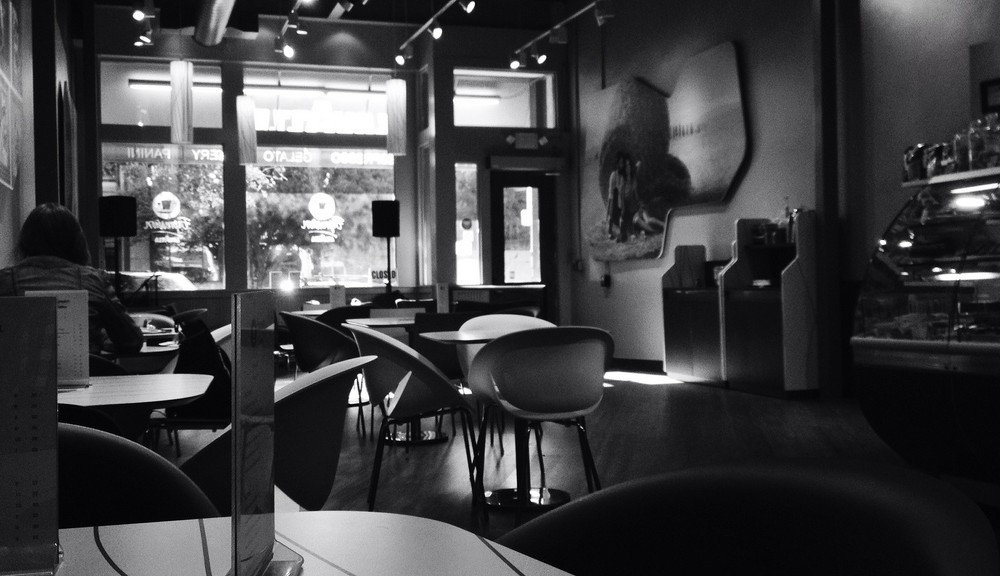
The average coffee shop is a quiet place, a library-like environment where people are heads down in their laptops. They’re a far cry from the classic London coffee house of the 17th century, where political debate raged, opinions flew wildly, and people bonded over a new-fangled beverage. We don’t interact, we co-work.
We seem to need excuses to inhabit communal spaces. Barker is right that working is the most common way to give ourselves permission to use public spaces, but some of the other “productive” goals that we pursue may be a little easier to subdue for the sake of restoring Oldenburg’s Third Places.
At my parish in Washington D.C., a pair of Dominican friars runs an “Adult Sunday School” program that teeters on the edge of satisfying Oldenburg’s criteria. When we meet in the rectory basement, we’re on neutral ground, the attendees are small-c catholic (people who wouldn’t have found each other otherwise), we’re there to ask questions, the location is accessible, the attendees are regular enough that even I’ve learned everyone’s names by now, it’s a cozy, low-profile environment, and the Dominican lecturers set the tone of earnest, joyful (and often playful) inquiry.
As for that last criterion—home away from home—there I think we fall a little flat. Although people show up a bit early to class after Mass, there’s very little lingering afterwards, even if there’s not another parish group waiting to use the room. Because our space exists only at a very specific time (10:30a.m. to noon on Sundays) it doesn’t have the drop-in, stick-around quality of a bar or a coffee shop or a living room.
The Sunday School class has served as the lead-in to extended, private, and casual social encounters for me. I’ve gone back to one of my classmate’s homes to bake scones or stuck around the neighborhood with another for lunch, but the afternoon has only ever been extended by leaving the space of our initial gathering.
I’ve observed the same pattern of scattering at most “goal-oriented” gatherings I’ve attended at nearly Third Places. My civic coding meet-ups disperse once our two hours of work are done, or, if socializing is to continue, we leave the space that we’ve shared for a louder, less intimate bar. Theatre talk-backs are closed with a final round of applause and the crowd rising in unison to leave.
I’m not suggesting that we bar the doors at the end of the structured portion of our events (that might be a little too coercive, not to mention illegal), but it’s worth finding ways to invite people to linger and to make themselves at-home after our goals have been met and we are “merely” enjoying each other’s company.
The idea is to glom on to the social spaces that exist and find ways to make them gateways to true Third Places. At my parish, it might be as simple as telling our class that we’ll always have the room until 2 p.m. on Sundays, and people might wind up packing lunch spontaneously so that they can stick around.
When I host an event of my own, I think that I’ll try holding some cookies or other baked good in reserve, and bringing it out at the official close of the event, to make it easy to stick around.
Even the work-dominated coffeeshops could have a go, by holding “EMP nights” that pair discounted drinks with a warning that, during the espresso happy hour, the staff will be unplugging the Wi-Fi for 30 minutes.
Restoring Third Places may not be a matter of finding so much the energy to start as opportunities to stay.