
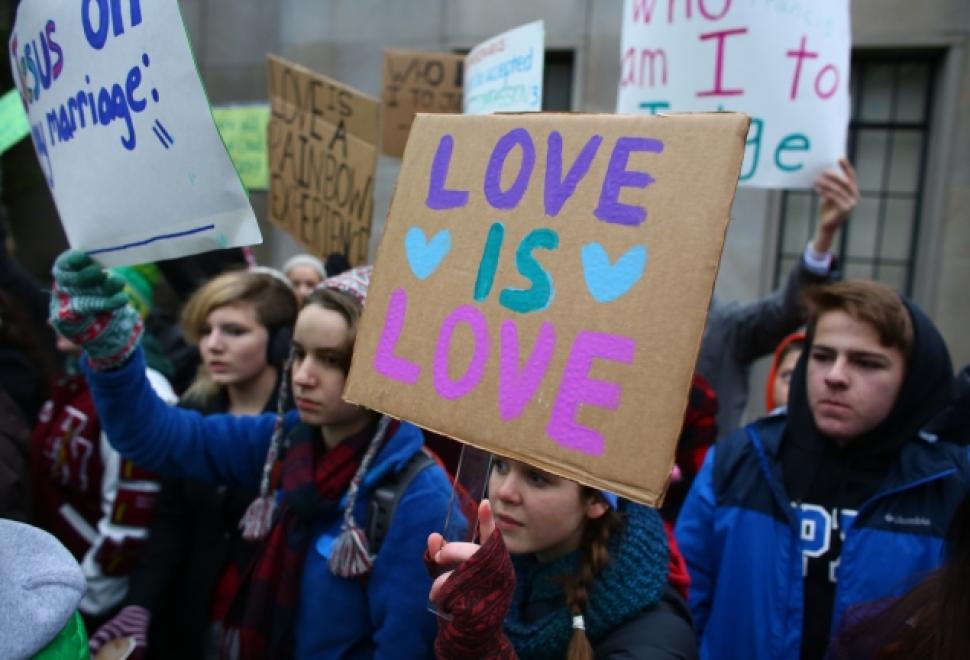
Millennials and Same-Sex Marriage

Timothy Kirchoff
By | September 28, 2014

Eighteen years ago last Sunday, the Defense of Marriage Act (DOMA) was signed into law with substantial bipartisan Congressional support. Since then, same-sex unions have slowly gone from that which politicians were embarrassed to admit they supported to that which politicians are embarrassed to admit they ever opposed.

This reversal of sentiments among politicians tracks very closely with millennials’ coming of age: Indeed, the general support among Americans under thirty for redefining marriage may be part of what has made these politicians so ready to reverse their public positions. Marriage redefinition is the civil rights issue du jour because the next generation of voters is overwhelmingly in favor of it, but it is worth considering why these opinions developed in the first place.

If you asked my peers, they might attribute this generational shift to basic human decency. They are not influenced by the same prejudices that affected previous generations. My peers would not be wrong to say this: The desire to see gay people fully accepted and integrated into society is a result of embracing basic human decency. It’s fairly obvious that variations in sexual orientation are not variations in levels of human dignity. This recognition is only facilitated by the fact that millennials can easily put a human face on the issue: Nearly everyone has or has had a gay mentor, friend, or sibling (or, failing those, any number of figures in popular culture). It is an easy argument to make, and it’s one that we’ve all been hearing for years. It’s no wonder, then, that it has sunk in.

That gay people should be accepted as full members of society is fairly obvious. That their relationships—or any set of romantic relationships—should be recognized as marriages is not as obvious as many take it to be. The institution of marriage itself is taken for granted with no explanation for why the state should be involved in the first place. We can see further evidence for this phenomenon in the fact that the suggested libertarian solution of getting government out of the marriage business has gained traction outside of those circles normally sympathetic to libertarian arguments.

Unlike the argument for the acceptance of gay people, the argument for the existence of marriage is not basic. It is not immediately obvious. It is a more complex argument, and it’s an argument that many young people haven’t actually heard. This observation—which I am far from the first to make—shouldn’t be surprising. As evidenced by the bipartisan support for DOMA, it was once possible to take for granted that nearly everyone would have at least a basic understanding of and appreciation for the importance of marriage and family not only for individuals, but for society as a whole. There was a time when people would have implicitly understood that it would be impossible to refer to any same-sex couple as married without a substantial redefinition of foundational cultural institutions, not simply a small change in the availability of legal benefits, and they could therefore accept DOMA despite its having been written by thrice-married Bob Barr, supported by Newt Gingrich (then on his second, and now third, marriage), and signed by that great paragon of marital fidelity, Bill Clinton.

This is not and cannot be the case with a generation for whom single parenthood and divorce are normal and for whom a successful marriage seems more like a product of luck than of mutual effort and dedication. We cannot accept arguments about the importance of marital norms from people whose devotion to and exemplification of those ideals is questionable at best. If we have been liberated of certain prejudices of our parents’ and grandparents’ generations, we have also lost whatever sense they may have had that marriage is a unique and integral part of the foundation and fabric of society. We are personally unbiased, but also socially uprooted.

Unlike the social acceptance of LGBT people, the social importance of marriage is not an issue with a face that every young person has seen every day at school or through the media—or, rather, it is not a face that we have been taught to readily recognize as such. The face of conjugal marriage is not the face that we see daily; it’s the one that we don’t see at all. It is the face of the parent who isn’t there—the face of the father or mother who, because of divorce, abandonment, or artificial reproductive methods like surrogacy or egg or sperm donation, is not present to take up the joyful obligations and wondrous burdens of parenthood. Once we learn to notice this absence, we will again be able to see the argument for the civil institution of marriage in the face of every child who has been denied the chance to experience the love of their own mother or father.

And yet giving a face to those affected by the redefinition of marriage will not be sufficient to convince millennials or society at large of the unique social importance of the institution. Putting a face on the issue will only open the door to a discussion about the fact that there has been a (not entirely intentional) redefinition of marriage over the last century, and that this cultural and legal redefinition has not been for the better. A healthy marriage culture is something for which neither a welfare state nor the legal recognition of every kind of relationship we can imagine from polyamory to bromance can compensate.

This is not an argument that most members of my generation have heard, but it’s one that we need to hear if we are to finally reverse the harm done by no-fault divorce and the redefinitions of marriage that both preceded it and followed in its wake. I know that I do not only speak for myself when I say that those of us who have stepped forward to articulate these points, even at the risk of being misunderstood, have often been surprised at how receptive our peers can be. Marriage is not an outdated institution in need of redefinition, but a foundational social practice in need of conscientious, compassionate, and determined defenders.


Print Friendly
  • Thomas Storck

    “The desire to see gay people fully accepted and integrated into society is a result of embracing basic human decency…. That gay people should be accepted as full members of society is fairly obvious.”

    So do you see no value in the idea that the public face of society should be heterosexual? I.e., that while people with same-sex proclivities should not be persecuted or hunted down, they should keep a low profile for expressing those proclivities?

  • pdxcatholic

    ” . . .while people with same-sex proclivities should not be persecuted or
    hunted down, they should keep a low profile for expressing those
    proclivities?”
    Interesting and valid point, but one that apparently has been lost on Cardinal Dolan for the sake of “goodwill.”

  • JGradGus

    Methinks ‘prejudices’ may not be the best word to use in your sentence, “They are not influenced by the same prejudices that affected previous generations,” since Catholic doctrine regarding homosexuality is not based on an irrational hostile attitude, fear, or hatred toward homosexuals, but on natural law. Perhaps “They are not influenced by the same mores . . .” might be more appropriate.

  • Timothy Kirchoff

    I would like to clarify that I was not referring to Catholic doctrine either in that sentence or anywhere in the essay (the closest I come is in a link to a post that just happens to be on Catholic Vote).

    Anti-LGBT prejudice is a real thing, and it does us no harm to acknowledge that.

  • Timothy Kirchoff

    Society ought to recognize the unique importance of the family and therefore of the husband-wife relationship, but even that doesn’t mean exalting any set of sexual preferences as such.

    We might also consider Michael Hannon’s argument that the very idea of
    heterosexuality is something of a historical novelty.
    http://www.firstthings.com/article/2014/03/against-heterosexuality

  • http://kanyewesteros.wordpress.com/ kanyewesteros

    This is a good article. The two main comments so far are pretty funny insofar as they present a microcosm of why the argument against same-sex marriage doesn’t have much traction with millennials: “well hold on, we can still be homophobic right?”

    no. you can’t. and if you cling to the idea that you can you’ll have even less a chance of defending your view of marriage.

  • Cato Major

    I would keenly interested to see what would happen if anyone, unbiased and rational and calm, were to press Bill Clinton or any other politician, Republican or Democrat, who made a turn around on this issue what they were thinking back then as opposed to now. I mean, really pushed them on their rational thought processes.

    Surely they did have their reasons.

    Not like we would ever get such an honest confession, but it would be interesting to see.

    At this point, I am nearly convinced we have lost this debate - not out of being wrong but simply a cultural revolution. To paraphrase Peter Berger, we are talking two different languages now. The same way that Aristotelianism was shut down following the Renaissance, and some Catholic intelligentsia like Marsilio Ficino scrambled to fit theology in a Neo-Platonic or even Hermetic mold. The talking stopped a long time ago. It seems to me that, without a strong theology of asceticism or philosophy of male or female friendship, we simply lack ideas to support the reconceptualization of human relationships. I would suggest we look back at the evolution of gender in Early Modern Europe for answers, but…

    As for today, it seems we ought to cut our losses and pull out of the marriage business. That, and possibly rework visitation and property rights to include other relationships besides marriage. I am not suggesting taxation benefits as those specifically require reproductive capacity, which obviously would not be entailed. Obviously, the Church ought to defend her own, but…

    I don’t know. I’m just getting very, very weary of this whole thing - especially with the picked up pace of this within the last five years in the Western world. I am not naive or provincial enough to think that the Churches are being “persecuted” or anything like that, especially given the truly diabolical goings on to the valiant Christians in the Middle East. We in the West are not. And bullying and lack of charity against individuals is a very real and reprehensible problem. I cannot not deny that.

    Yet the Churches can’t do anything without this being brought up in some capacity, and this issue has come to overshadow everything else that the Churches are seeking to do, whether it’s economic/social justice for poor and oppressed, re-evangelization, infusing liturgical beauty in the world and teaching the philosophy of Christ. It’s another lawsuit in another Catholic school, another protest on the part of students…

    More evidence of the utter failure that is theological education today.

    Call me pessimistic, but I see a dim future for the Churches on the public square. It’s like we are walking amid another of Johann Huizinga’s ages - a slow, inexorable, “autumnal” waning. Maybe I just move in the wrong circles, in graduate school. As someone in my twenties, I am living and will be living in this brave, new world for a long time.

    Is Pope Francis’ popularity a flash in the pan? I do not know.

  • Timothy Kirchoff

    Out of curiosity, have you read Joseph Bottum’s essay, “The Things We Share” or the three reflections on it from earlier this summer? Much of what you say reminds me of those pieces.

  • Cato Major

    I will do that. Thanks.

  • Timothy Kirchoff

    I bring it up Bottum not only because your thoughts remind me of some of his, but also because I wrote my own response to some of his arguments at the beginning of the summer: http://ethikapolitika.org/2014/06/16/discovering-share/

    My piece opens with links to Bottum’s essay as well as the more recent responses to it: if nothing else, it’s an easy way to find them all.

  • Edgardo Tenreiro

    The involvement of the state in matters of matrimony is recent and has its origin in Protestantism and the French Revolution. Prior to that, it was a matter of Cannon Law and prior to that a private matter between the parties to the marriage. We’re in the current mess because we have blindly accepted the Protestant and French Revolution paradigm.

  • Thomas Storck

    Yes, I’m aware of the argument in First Things (or similar arguments at least), and that’s why I said “people with same-sex proclivities,” not homosexuals or gay people (as you did) - exactly to avoid such “essentialism.” But in my first sentence I did use “heterosexual” - I should have said something like “public face of society should reflect the natural orientation of human nature toward sexual expression and conduct.”