Political Correctness and the University’s Pink Police State

In his 1953 book, The Quest for Community: A Study in the Ethics of Order and Freedom, the sociologist Robert Nisbet sets forth an explanation for why many men and women join totalitarian movements, such as the fascism that preceded Nisbet’s book, the communism of his time, or something like Islamic State today.
In the preface, Nisbet notes that the “real significance of the modern state” lies in its “successive penetrations of man’s economic, religious, kinship, and local allegiances, and its revolutionary dislocations of established centers of function and authority.” These penetrations into the space of civil society—those autonomous institutions existing between the individual and the state—Nisbet believes to form the framework for “the twentieth-century’s obsessive quest for moral certainty and social community,” which make “so difficult present-day problems of freedom and democracy.”
New York Times columnist Ross Douthat, discussing our “Age of Individualism,” writes that for Nisbet “it was precisely the emancipation of the individual in modernity — from clan, church and guild — that had enabled the rise of fascism and Communism.” With the advance of a further fractured and atomistic culture, “The advance of individualism thus eventually produced its own antithesis — conformism, submission and control.” Elsewhere Douthat mentions that while the totalitarianism, “fascist and Marxist, that shadowed Nisbet’s writing isn’t likely to come back,” instead “a kinder, gentler kind of authoritarianism — what the blogger James Poulos has dubbed “the pink police state”… remains a live possibility.” When interviewed by The Atlantic, Poulos explained the meaning of this term, “The Pink Police State”: a state of affairs in which cultural libertarianism snowballs with greater state extension into the space of civil society (which the state is supposed to extend and sustain as much as possible):
[A] growing sphere of libertinistic freedoms compensates (or more than compensates!) for our shrinking spheres of political liberty and the practice of citizenship … So citizens of a Pink Police State (I should say subjects) are apt to surrender more and more political liberty in exchange for more and more cultural or ‘personal’ license. And the government of a Pink Police State tends to monopolize and totalize administrative control while carving out a permissive playpen for the people.
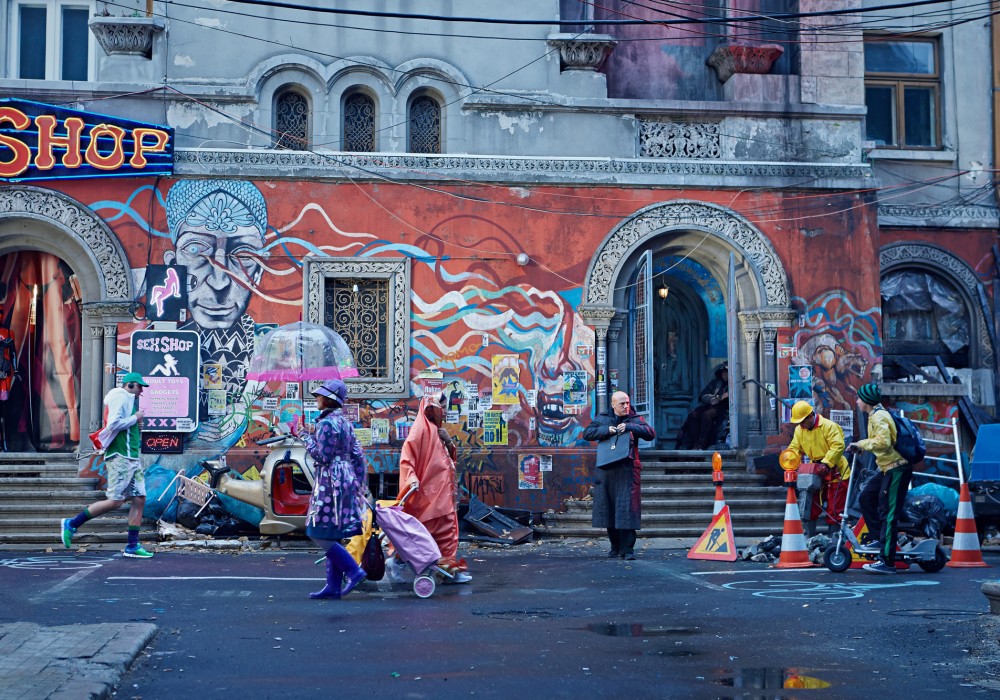
The Pink Police State (PPS) is a state in which private license is boundless, while public freedoms of communal organization are stringently limited. The Pink Police State is the making of a dystopic Terry Gilliam film.
Something analogous to the PPS was proposed long ago by Alexis de Tocqueville when he spoke of soft or mild despotism in his work, Democracy in America. Political theorist Harvey Mansfield notes that in contrast to the tyranny under monarchy (“the absolute government of one alone”)—in which “despotism would strike the victim’s body in order to reach his soul—democratic despotism “leaves the body and goes straight for the soul.” “Democratic despotism,” Mansfield explains, “is “mild despotism,” not torture and execution but moral and intellectual domination, not hard but soft” (Tocqueville: A Very Short Introduction, 41). Tocqueville was anxious of a future loss of taste for free institutions:
The democrat, we know, readily becomes a victim of individualism, the enervating sentiment of weakness that turns citizens into isolated individuals concerned only with their private lives. When they do this, the state is left as the only visible and permanent representative of the community, and individuals leave their associations as they develop a natural inclination to let the state take care of all common affairs. The sort of despotism democratic nations have to fear, then, is mild. Far from frustrating their desires, it satisfies the worst of them. The worst desire in democracy is abandonment of the pride that sustains one’s independence and loss of freedom, thus degrading men without tormenting them, without arousing their opposition or even giving them notice of what they have lost (Mansfield, 78-79).
Tocqueville said that these democratic men were becoming a “crowd of like and equal men … procuring the small and vulgar pleasures with which they fill their souls.” Each man exists “withdrawn and apart” and “only in himself and for himself alone”: above them “an immense tutelary power is elevated” to alleviate “the trouble of thinking and the pain of living.” Tocqueville calls these socially atomized and state-dependent people “a herd of timid and industrious animals of which the government is the shepherd” (quoted in Mansfield, 79-80).
(I certainly do not say that fellow citizens financially dependent on the state—e.g. those relying on a social safety net, especially in a time of recession—are this herd. Far from it.)
However, when an increased culture of private license satisfies primeval desires—for food, sex, power, and so on—in conjunction with an increased stranglehold by the state, one sees how this soft despotism of the PPS can manifest itself: A citizenry without virtue cannot sustain the shared space of civil society and so the state steps in like the Grand Inquisitor to permit everyone to sin at his heart’s desire, but retain tight control over how the subjects organize in public space.
While the idea of the PPS is dystopic and therefore now not fully immanent, I mention Poulos’s term since it seems to somewhat too accurately describe where the current zeitgeist of political correctness is taking us if Americans continue to affirm it in our choices and habits: a quasi-Huxlean Brave New World where the state monopolizes and totalizes “administrative control while carving out a permissive playpen for the people.” It is no secret that political correctness—defined in Webster’s Dictionary as “conforming to a belief that language and practices which could offend political sensibilities (as in matters of sex or race) should be eliminated”—is a predominant “liberal” virtue in pop culture and academia. The philosopher Roger Scruton says that political correctness makes universities “these closed, ideological sort of concentration camps.” Admittedly, such language is stronger than the language of Shakespeare’s Marcus Andronicus when he decries the silenced and raped Lavinia. However, such language seems intelligible at a time when The Harvard Crimson can openly publish an article (as it did last February) that demands the firing of Mansfield and replacement of academic freedom with so-called “Academic Justice”—“When an academic community observes research promoting or justifying oppression, it should ensure that this research does not continue.”
It may be the case that “Academic Justice” is not necessary since most research already fights “oppression” of whatever the current identity politic zeitgeist happens to be. Yet the university often can feel like a Pink Police Campus for contrarian students. The late philosopher Richard Rorty summarizes the recent cultural revolution in the arts and humanities thus: “a new American cultural Left has come into being made of deconstructionists, new historicists, people in gender studies, ethnic studies, media studies, a few leftover Marxists, and so on. This Left would like to use the English, French, and Comparative Literature Departments of the universities as staging areas for political actions” (quoted in Roger Kimball, Tenured Radicals, 3). The arts of humanities curricula (at the immeasurable cost of traditional literary studies that disinterestedly separated high culture from pop culture) have been politicized, exposed, and subverted for a particular type of leftwing ideology. I know many liberals who decry postmodernism or the cult of identity politics on campus. Nevertheless, this revision has made higher education an indoctrination into the ideologies that Rorty identifies, and the norm that governs such “study” is political correctness. Contrarian students have little else to do save stay in an observant silence for four years. An easy example is any student who privately affirms the conjugal view of marriage and would not openly do so in the classroom. Political correctness cuts out the tongue of real political debate.
The French historian Pierre Manent includes a very interesting analysis of political correctness in his most recent book, Metamorphoses of the City: On the Western Dynamic. He notices that in Europe today, “the civic operation is feeble and the religious Word almost inaudible. The two poles between which the Western arc was bent for so long have lost their force” (10). In Western Europe, the space of civil society has atomized political organization and open religious affiliation relative to previous epochs. There is the obvious retreat of mainstream Protestantism and the decline of Catholicism in Europe, and the less obvious lack of functional parliamentary regimes, since the European Union continues to subsume local and nation-state powers and responsibilities. With this atomization of recent times, “political speech has been progressively severed from any essential connection to a possible action. The notion of a program, reduced to “promises,” has been discredited. The conviction has spread, whether explicit and tacit, that in any event one has no choice. What will be done will be dictated by circumstances over which one has no control,” Manent writes (11).
Political speech has been divorced from political action—a belief in fatalism derived from the separation of political action form political speech has destroyed the security necessary for exercising individual and group political action in civic participation. This loss of belief in capacity for action itself inhibits the exercise of action. Political correctness thus results as a confusion of political word for political action—so saying the wrong words is doing the wrong action. If I say something that disagrees with your position or lifestyle, it may be taken as an actual assault on you, the person. Manent observes,
Political correctness is a particularly significant aspect of the contemporary emancipation of speech. One no longer expects that speech will be linked to a possible action; thus it is taken seriously as though it was itself an action. Not being linked to a possible and plausible action that measures its purport, speech is willingly considered, if it is unpleasant, as the equivalent of the worst action imaginable. Thus one tracks those infamous words that are designated as “phobias” in clinical language (11).
Manent concludes that while the “progress of freedom in the West consisted by measuring words by the Yardstick of visible actions,” political correctness instead “consists of measuring words by the yardstick of invisible intentions” (11). P.C. is the virtue of invisible intentions.
Virtues, however, cannot be gained by “identifying” with others psychologically—a virtue is the skill of an action performed repeatedly over time. As Aristotle said, since we are what we repeatedly do, character is a habit and not an attitude. To fight this decadent culture in the academy, pointing it out and criticizing it is not sufficient. As Roger Kimball notes, “those who want to retake the university must devote themselves [to] cultivating those virtues” of candidness and courage, “and perhaps even more to cultivating the virtue of patience, capitalizing wherever possible on whatever local opportunities present themselves” in exercising them (Tenured Radicals, xlvii).
The quest for a community of order and virtuous freedom, especially in academia, requires that we continually renew ourselves with practiced virtue in the space of civil society and thus renew the background culture from which the university is formed and campus life is informed. Only when women and men expand the shared space of civil society by expanding their habits in virtue, may the Pink Police State remain a Terry Gilliam film only and not a reality in the not-so-distant future.