
Jeremiah and the Enlightened Racist

David Mills
By | September 1, 2014

“The problem,” writes Nicholas Kristof, “is not so much overt racists. Rather, the larger problem is a broad swath of people who consider themselves enlightened, who intellectually believe in racial equality, who deplore discrimination, yet who harbor unconscious attitudes that result in discriminatory policies and behavior.”

This problem seems obvious to me, but many people—especially political conservativesamong those who consider themselves enlightened continue to claim that racism is no longer a problem in America and imply that what racial disadvantages remain are black Americans’ fault. Many who don’t deny the reality of racism suggest that it is no longer a problem by directing their attention and indignation in any racial controversy to anything but the problem, instead criticizing opportunistic race hustlers like Al Sharpton, for example, or talking solely about how far the nation has come, or treating any concern with racism as white liberal self-flagellation.

Judging from their reactions, most don’t seem to believe it possible that racial prejudice is a deep problem, nor to suspect that their reaction to that possibility might express their own unrecognized prejudices. They rarely talk about racism as a causal factor in American life.

Kristof presents the dismaying evidence for his thoughts about the “enlightened.” For example, a study of the way people evaluate résumés:

Two scholars sent out nearly 5,000 résumés in response to help-wanted ads, randomly alternating between stereotypically white-sounding names and black-sounding names. They found that it took 50 percent more mailings to get a callback for a black name. A white name yielded as much benefit as eight years of experience, according to the study, published by the National Bureau of Economic Research.

One study using a video game found that players shoot at armed black characters quicker than they do at armed whites and holster their weapons quicker for unarmed white characters than for unarmed blacks. This is creepy.

Kristof directs his attention to the “enlightened”those who think that they’re not racist but are so at levels they don’t recognize, which would include almost all of us. (I’m thinking of people likely to be reading this website and its peers.) That, speaking as one of the people whom Kristof describes, we harbor racist assumptions without knowing it seems, as I said, kind of obvious, though it’s very useful to have studies to prove it because it’s one of those obvious truths we don’t like to admit and whose expression we neither see nor understand.

This would be true for anyone whose race or culture has a longstanding dominant and oppressive relation to another. Listen to many Englishmen talk about the Irish and at some point you will hear something assuming their fecklessness and childishness, and the speaker will not realize that he’s said anything bigoted at all. Listen to many people of all sorts talk about the Jews and you will often hear some shockingly overt statement of antisemitism, again said with no consciousness that it’s an expression of bigotry. Listen to some wealthy people talk about the middle class, never mind about the poor.

Kristof notes what he calls the “remarkable” progress in America, offering as evidence the increase in those who approve of interracial marriage, from just 4 percent in 1958 to 87 percent today. (It’s a little disturbing that one in 8 Americans still rejects it.) But I thinkno, I knowthat a large portion of that 87 percent would freeze open-mouthed were they to go to the front door to meet their daughter’s fiancé and find a black man standing there.

Prejudice doesn’t always flow out, like dirt from a dishcloth in the wash. It also sinks in, like ink into a sponge, or better, like water into a carpet that dries on the surface but feeds mold underneath. The overt racism of our ancestors, which we find repellent, becomes in us after two or three generations a feeling that there’s something different about black people, something not quite right, or at least not quite us. You don’t see this feeling in yourself, of course, but you act on it.

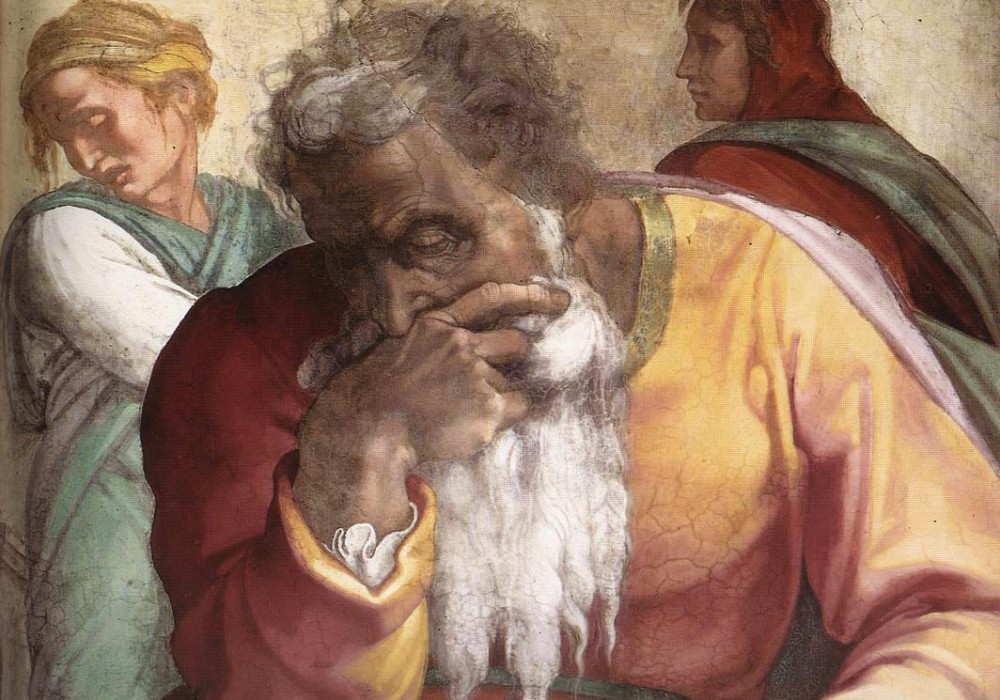
For the Christian, this is only Pauline or Augustinian realism. (That is, a realist view of human nature that conservatives are supposed to endorse but don’t always.) As the prophet Jeremiah noted, “The heart is deceitful above all things, and desperately wicked: who can know it?” The heart, the organ of perception, is corrupt and deceptive. Among its deceptions is telling you that you are a better person than you arein the matter we’re discussing, that enlightened white people are edenically free of prejudice against black people.

It isn’t true, and the illusion that it is leads us to fail in that sympathy for the poor and marginalizedin this case our black fellow Americanscentral to the Christian life, part of which is taking their claims and their stories seriously, and not thinking so highly of ourselves that we can’t hear what they have to tell us.

Print Friendly
  • Mary Ann

    Depending on where you live in this country or in the world, prejudice varies by skin color, religion or socio economic groups. In this country alone there is prejudice against Mexicans, Cubans, Native Americans, Middle Eastern, Jewish, and even reverse discriminating against “white” Americans depending on where you live. I worked with a woman who told me she would not be happy if her son showed up at her door with a white woman. It’s universal and world wide. Even if we were all the same skin color and looked identical we would find some way to elevate ourselves above others. We can strive for sainthood but seldom do most of us reach it. It is what it is…we can try to do our best to recognize our prejudice but I’m not naive enough to think that it’s going away any time soon. Most of us live on earth not heaven.

  • RaymondNicholas

    I suspect that if you listen to “what they have to tell us” it will lead back to fifty years of failed liberal policies with the tacit support of conservatives. For example, get those scholars to do a survey of public high school graduation rates and math and reading comprehension, and see how whites and blacks compare. From what I have read, the differences are stark. Taken in a different context, such as the racial diversity in the Ferguson police department, cries of racism would abound. Why are those voices silent when it comes to education, or any other measurable demographic wherein the comparisons are unequal? Could it be that diversity gained through multiculturalism and moral relativism, and tolerance of every form of unsavory behavior are the ways and means whereby the covert racist succeeds?

  • Tonestew

    I appreciate this piece, thank you for challenging us to examine ourselves. It is always best to deal with one another in relationships instead of as groups whether it be ethnic, political, etc. And it is also best to realize that we all have racial and social baggage that skews our view of others no matter who it is. Let’s try every day to be better versions of ourselves.

  • Ralph Coelho

    We
    are born in the image of God with innate prejudices and biases. The conversation
    of God with Adam and Eve shows up some of these. Consider Eve’s argument that she ate the Apple because it was
    good, that it was her fault that Adam
    ate because she gave it to him. Typical woman characteristics, since seriously modified?
    Or consider Adam’s response –
    apparently aggressive, blaming God and Eve.
    One sees the sprouts of the patriarchal culture - man’s and woman’s response to
    each other. And still God said his creating of man, male and female, was good?

    Remember
    that Jesus virtually rebuked (or
    corrected) the young man for calling him Good? Was he speaking as man? Was he telling
    him that he should constantly search to be good and selling all he has was the
    first step?

    Racism
    is one of the many biases that plague society today. The rejection of an
    absolute system of morality for a relativistic system provides a soil in which
    these biases sprout and flourish.

  • Antiphon411

    Do you think that there are some among the thousands of saints from the last nearly 2000 years (canonized and un-canonized) who would have been upset if their white daughter or niece showed up at the door with a black fiance? (I would imagine that many would have been.) For those that would have been, do you think that they repented specifically for this latent racist attitude before they died? (I doubt it.) So if racist opinions do not prevent one from entering heaven are they sinful? If not, then what is the big deal?

  • Antiphon411

    I still don’t get this big discussion that has been going the rounds among liberal-moderate-conservative Catholic blogs these days? How is being real about race un-Christian or sinful?

    Is it a sin to recognize that blacks commit a disproportionate number of crimes in America? (It doesn’t really matter why they do.) Would it then be a sin to avoid black neighborhoods? Would it be a sin to desire that significant numbers of blacks do not move into your neighborhood? Would it be a sin to pull your children out of a school that is becoming increasingly black? Why? One doesn’t have to hate black people to notice that large concentrations of them tend to cause trouble.

    I would say that it is a sin to go out and kill black people because they are black. That sin is called murder. I would not call it a sin to think that blacks are generally less intelligent than whites or Asians. Indeed, in my years of teaching, I have noticed that my highest performing students are rarely, if ever, black.

    I would not be happy if my daughter brought home a black boyfriend (not least because she’s only 9!). God created different races and different cultures and ethnicities. I think that it is good to try to preserve those and allow each to bring its gift to the human experience.

    It would be interesting to see what theological writers of previous centuries thought about miscegenation and racial issues. I know that the writings of St. Alphonsus Liguori and others contain items that would now be considered sexist. They are still saints and doctors of the Church. What to make of that?

  • Antiphon411

    Or let’s try to appreciate reality. I think that it is great to get to know individuals. Many “racists” have good relationships on an individual basis with people of different races. “Racism” is based on averages. If a large group of black youths walks into your store, it is quite possible that they are a church choir just stopping in to purchase goods in an orderly fashion. It is also possible that they are there to cause mayhem. The likelihood of the latter case is higher than for a group of East Asians or Jews walking into your store. Being aware of this is not a failure to become better versions of ourselves-whatever that nonsense means.

  • http://batman-news.com Stephen Peterson

    It is sinful to judge a person based on a generalisation based on a sterotype. Just because most crimes are committed by black people, doesn’t make most black people criminals, and it certainly doesn’t make the black person (or white person, for that matter) you’re talking to a criminal. What you’re describing isn’t just racism, it’s paranoia.
    God didn’t “create” different races and cultures - God created Man (Gen 1:21). Divergence in race and culture came about as a result of our sinful human nature (Gen 11:4-9).

  • Antiphon411

    Hypothetical situation: I am walking home at night. There is a shortcut to my apartment through a park. I start to go through but notice a group of black youths loitering on some benches. I decide to go another way. I have sinned?

    You have a very broad definition of “judging”. I have not thought to myself, “These black youths are criminals and sinners and deserve to be in hell!” Nor have I taken any action against them. I have merely made a calculation based on my knowledge both statistical and anecdotal that it is safer to avoid a group of black youths in a park at night.

    So, a sin, right? Point me to a text that says so. Though I normally put little stock in the new Catechism (I prefer the Roman or Baltimore Catechisms), you can even direct me there.

  • http://batman-news.com Stephen Peterson

    There is a moral difference between being upset by something and acting upon that upset in a prejudicial manner. That is the difference between a saint and a sinner.

  • http://batman-news.com Stephen Peterson

    “Realism is simply Romanticism that has lost its reason…that is its reason for
    existing.” ― G.K. Chesterton, Alarms and Discursions

  • http://batman-news.com Stephen Peterson

    So, you’d feel safe walking through the same park if you saw a group of white skinheads instead? What is the significance of the loitering youth being black?

  • Antiphon411

    Regarding the skinheads, social context would be important. If it was well known in my town that they represented a criminal element, I would avoid them. Otherwise, I would have no problem and would probably exchange pleasantries with them as I walked past.

    All things being equal, I would not be overly concerned with any group of whites in that situation. If some good ol’ boys were having a few beers in the park, I’d be fine. A group of Orientals would be fine. Even Latinos, I suspect would be fine, provided that they did not have obvious gang affiliations or aspirations.

    Blacks, not so much.

  • ChrisZ

    Here’s the “progressive” mantra I would hear in college 20-some years ago: “Everybody’s a little bit prejudiced.” It was meant to be a pat-on-the-back affirmation of broadmindedness on the part of the speaker, but in practice it was also a way to draw listeners into making an admission, supposedly on “safe” ground, that would later be turned against them. That pose was superseded more recently by a kind of liberal-supremacist mantra: “Only conservatives / Christians / Republicans / whites are prejudiced.” If Kristof now wants to reintroduce the “Everybody’s a little…” pose, good for him; but forgive me if I find him an untrustworthy spokesman. Liberals have shown too much bad faith in this matter, for too long.

    The problem that David outlines is as old as civilization: the love of one’s own-which Plato called the root of all injustice among mankind. It is so intractable that, even after the lengthy discourse of the Republic, Plato’s Socrates found he could not eradicate love of one’s own from the city in speech. Perhaps that’s because for all its downsides, love of one’s own has many positive consequences, including some that are intrinsically human and humane. To truly eradicate it would be to sacrifice the good with the bad.

    David points to a remedy that is also Socratic: self-knowledge; awareness of the human problems, and consciousness of our own participation in them. I stand with that humane perspective. But the human problems are truly human-that is, universal, exempting no one, and no group. What is frustrating is to know that one needn’t look far to find Christians or conservatives grappling with the question of their own prejudices; but where do you find people from other backgrounds grappling in the same way, and without accusatory finger-pointing?

  • oregon nurse

    “They found that it took 50 percent more mailings to get a callback for a black name.”

    I think this touches on part of the white/black racial problems in this country. Among many blacks there is a very intentional effort to be different from whites. A not so subtle rejection of white culture/society which unfortunately tends to cut them off from achieving many ‘markers’ of success since the culture they live in is indeed a white European one. I notice this a lot in education where the white school system isn’t thought by blacks to teach them anything relevant beyond grade school. The trouble is they don’t have an alternate socioeconomic identity that is working for them. This leads to a cutting off of their nose to spite their face and deep anger and resentment even toward those who harbor no ill will against them.

  • pt8685

    Recognizing racism in our own thoughts is disturbing.

    But its time to recognize that, unlike in days past, at the root of this modern hidden racism is not a cultivated philosophy of racial superiority, but a primal defense mechanism buried deep in our DNA. We naturally suspect and fear strangers.

    The question at this point is less about how we change society to end racism, and more about how we individually discipline ourselves to overcome our basest, mindless animal instincts.

  • Chris

    Alternatively, you could notice that in education, the “white” school system is punitive towards black students starting from grade school onwards. A parent who realizes that (based on clear evidence from those around you) their child will be 2/3 less likely to be paid enough attention to to diagnose with ADD or ADHD and instead will be 3 times more likely to be suspended for “disruptive” behavior from preschool on might leave you with less interest in the current school system.

    As a student, knowing that in every grade you will automatically be assumed to be significantly less intelligent than your classmates, not expected to succeed, and thus not given any help or introduced to opportunities to excel (like advanced courses and college counseling), might make you consider “checking out.”

    Sure, black students can overcome some of these obstacles and maybe some of them aren’t erected out of “ill will,” but note that that is an extra burden that “white society” doesn’t have to deal with.

  • Smith

    Orientals, really?

  • oregon nurse

    I didn’t try to make one side or the other right or wrong. I was merely pointing out that (pragmatically) if one lives in a dominant culture it makes sense to either live in the culture or have an effective alternative if you choose not to (the Amish come to mind here). Much of black culture rejects the dominant white European culture - which is fine but they haven’t replaced it with anything that ‘works’.

  • Antiphon411

    Yes, it was my impression growing up in a very Korean part of Los Angeles and being on friendly terms with some Korean gang members and many Koreans who weren’t that they tend to prey on their own. I believe that the same goes for Chinese and Japanese. Perhaps that has changed?

  • David Gray

    Maybe they shoot black characters more quickly in video games but not in real life.

    Study: People Faster to Shoot White Suspects than Black Suspects

    http://reason.com/blog/2014/09/03/study-people-more-likely-to-shoot-white
    We are all prone to sin in every aspect of our lives and it is good to be reminded of this. But efforts to deal with this in society will never achieve much positive until society allows this discussion to proceed without the need to lie (by ignoring them) things like roughly 1 in 2 violent felonies in this country is committed by a black man, generally young. Or that a majority of black children are born bastards because their parents didn’t care about them enough to provide a home and marriage. That last one Jim Crow couldn’t manage but modern society has. Real love involves sympathy and empathy but it also involves the truth. And it is a tiny needle to try and thread.

  • msmischief

    I know that “black name” vs “white name” study.

    You know what name did the worst? Geoff — a white male name. Many black names did better than white names.

    Those who have looked at the name list concluded that what it is is that odd and unusual names are worse off.

    However, the effect is not lasting. One economist did the laborious work of investigating whether slum-born children with typical names did better than those with odd ones, and concluded that in the long range, they were no better off.

  • http://batman-news.com Stephen Peterson

    A quick Google seach for “racial realism” should confirm to you that, not only is this concept immoral, but it is also completely unscientific. Trying to justify racism in the name of realism is really not okay.
    Racism itself is a relatively modern concept, and its promoters were predominately “Enlightenment” thinkers. The “Enlightenment”, of course, was a way of twisting reason to justify being an arse. I challenge you to find anyone representing the Catholic tradition (there are plenty in the Protestant tradition, however) who supports racism.

  • David Gray

    One of themselves, even a prophet of their own, said, The Cretians are alway liars, evil beasts, slow bellies. This witness is true. Wherefore rebuke them sharply, that they may be sound in the faith; (Tit 1:12-13)
    Racist?

  • Stephen Peterson

    Since “race” is a modern concept, absolutely not! The Cretians weren’t a race but the inhabitants of a particular city/island, most of whom were of Greek ethnicity. If the context, in fact, Titus is referring to both the Greek and Jewish inhabitants collectively. Not to mention, the prophet he refers to is himself a Cretian citizen.
    By contrast, what you Americans call the “Black Race” are a collection of peoples of various ethnicities, of which the only thing they have in common is that their ancestors were exploited as economic slaves. By contrast, your so-called “White Race” is also a collection of various ethnicities (although far fewer than what you’d call Black), the only thing with which they have in common being that their ancestors had legislative privileges. These are concepts that migrants brought to America with them from Northern Europe (the idea of “blood and soil”), which, incidentally, became the foundational concepts of national socialism in the Old World.
    Sorry, guys but the onus is really on you to prove that a concept of race even existed before Modern times.

  • David Gray

    Well if Cretians were a mix of people of various ethnicities and what you call the “black race” is a mix of people of various ethnicities then perhaps we’re on the right track.
    I suspect if one was to make the same statement and replace Cretians with “residents of Detroit” it might not sit well.
    We are often so very worried about stereotyping. If that is really a problem it is hard to see how Paul would not be guilty as well. Perhaps the things that offend us most are things that don’t concern the Bible and God so much, at least not within the contructs we use.

  • Stephen Peterson

    Neither the Jews, nor Greeks, were races or ethnicities the way you understand them. The New Testament Jews identified themselves as the descendants (tribes) of Judah and Benjamin, who had in common an obligation to maintain a particular set of covenants with God. The Greeks were the citizens of various Mediteranian cities of varying cultural, political, and mythological persuasion who had as their common identity their collective mission to preserve what they called “civilisation” against the hordes of Barbarians (those for whom Greek wasn’t a first language).

  • http://batman-news.com Stephen Peterson

    The so-called “Black Race” you Americans refer to are more akin to the biblical/ancient concept of feedmen, those who have been freed from slavery along with their decendents, such as those refered to in Jeremiah 34:8-22.

  • RipVanHalen

    I don’t deny that there is racism, nor that I sometimes have inappropriate first reactions to people of other ethnicities, but I do have some quibbles with the assumptions which often form the foundation for columns like this one. First is the focus upon “white on black” racism. Whenever the R word “comes up” as an issue, what kind of racism is it that is being broached? Over 99% of the time, it is the white on black variety. Since whites know they are not the only ones guilty of this, the natural tendency is to be defensive and/or resentful. And Christians are no less prone to this reaction than anyone else. In fact, they may be even more defensive and annoyed by the way the topic is discussed because if they have well-formed consciences they may be among the least guilty!
    My other observation is about a double standard that seems to apply when giving a person the benefit of the doubt. It seems to me that skin color plays an inappropriate part. As I white person I am nearly always admonished to always (yes, the two instances of “always” is intentional) give a person of different ethinicity the benefit of the doubt, and to not stereotype him or her- after all, the person I am prejudging may be very different from what I imagine. Quite true, and quite fair. But what of the other direction? What makes it OK for certain civil rights activists and armchair social theorists to make pronouncements about the secret thoughts and motivations of all white people?
    I believe that these two factors are significant stumbling blocks on our way to getting all the different folks to see reasonably clearly about this issue.

  • Glen Kissel

    Pinpointing racism is quite easy: start with the Obama-Holder Justice Department.

    They aggressively support states that check the skin color of their citizens, and if the skin color is black, the citizen is held to a different standard, a lower standard, in state hiring, state contracting and university admissions.