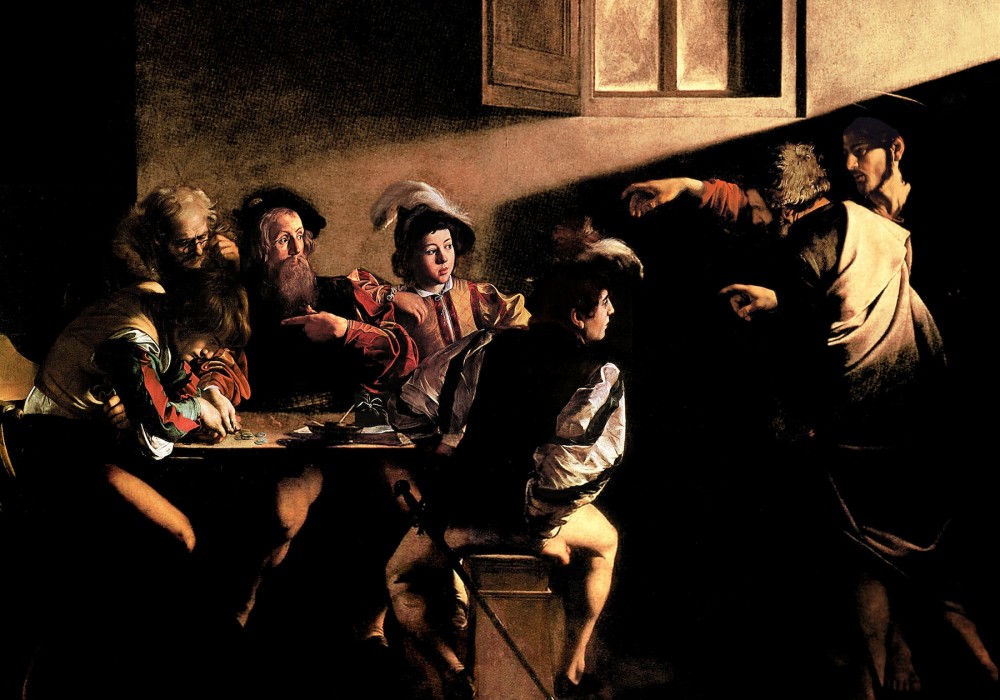
The Calling of Saint MatthewMichelangelo da Caravaggio, c. 1599

Is Capitalism Compatible with Conversion?

Andrew M. Haines
By | June 20, 2014

Ethika Politika’s recent series on “virtuous capitalism” tackled a number of points concerning the common good vis-à-vis the aims and methods of a market economy. Doing it all in just 500 words was a challenge, yet a connecting theme emerged that Christian anthropology requires more of us than strict conformity to a systematized worldview.

Stephen P. White made the case against (practical) materialism, arguing that poverty is more intensive than clickbait headlines would suggest. Similarly, Andrew Kidd recommended looking past the capitalist-communist divide to “see ourselves primarily in an interpersonal relationship with all people of society.” For his part, Jose Zeron gave strong admonition against the “perverse incentives” of self-seeking capitalism, where virtue is “implicitly discouraged.” And most recently, Morning’s Minion argued for the fundamental incompatibility of libertarian and Christian anthropologies.

If anything “synthetic” can be said about “virtuous capitalism” as a result, it might only be that most think it’s at least an incoherent phrase, if not also somehow damaging. (Sorry, Cardinal Dolan.) From a holistic point of view (via Morning’s Minion), capitalism is taken to oppose classical Christian virtue since its telos is at odds with the natural social end of man. Each demands a total investment of oneself—especially if we are to understand self-ownership as a prerequisite for authentic capitalism—yet only one allows, in the words of Pope Benedict, for “human relationships of friendship, solidarity, and reciprocity [to] also be conducted within economic activity, and not only outside it or after it.” From an analytical perspective, on the contrary, capitalism just isn’t the sort of thing that can take a predicate like “virtuous.”

For my part, both of these critiques make sense. Yet I think another point can be made concerning the very example that spawned the phrase “virtuous capitalism” in the first place, and which is indispensable to scrutinizing the Holy Father’s much-embroiled approach to questions of economy: namely, the scriptural story of Christ and Zacchaeus. Sadly absent from Dolan’s account is the personal encounter and vocation that precipitates Zacchaeus’s “radical decision to put his economic wealth at the service of others.” It’s not as if this virtuous act was spontaneous, motivated by Zacchaeus’s heretofore rational decision making. In fact, it cascades from a direct intrusion into that process: Christ commands to him—in response to Zacchaeus’s attempt to optimize his vantage point from the sycamore tree—Zacchaeus, come down quickly.

From there, things happen fast; and indeed Zacchaeus’s conversion is one of “inspiration.” But it’s also very much a conversion.

Quoting Dolan, “virtuous people, acting justly, compassionately and honestly, are the foundation of good economic or business activity that can produce prosperity for all, and not just for a few.” Yet virtuous people—especially of the compassionate Christian variety—aren’t formed only by rational decisions or chasing equilibrium. Just as well, the virtue they espouse—like the sudden self-emptying of Zacchaeus—is incompatible with an anthropology of absolute self-ownership. An economic system is neither the source nor the end of Christian right action.

If this doesn’t muddle a concept like “virtuous capitalism,” I don’t know what could.

Editor’s note: This article is part of a series on “virtuous capitalism” designed to explore the topic in 500 words or less. The entire series may be found here.


Print Friendly
  • http://www.RestatementOfTheObvious.com/ JonMarc

    Good article Andrew. This at very least should be a point of agreement among proponents and critics of capitalism: that the concept of “virtuous capitalism” is a muddy one. Even if it could work, even if it had to work in the case of any steps forward toward something else/better, we would still do well to take the inherent muddiness of the concept as a foundation for constructive dialogue.

  • rjfarel

    The conclusion is true, but it seems so obvious that I can’t see its usefulness. There is only one alpha and one omega for anything. Sexual orientation, political bent, skin color, automobile brand loyalty, you name it, can pervert one’s sense of right action.

  • Mattias A Caro

    It’s interesting how important the story of Zacchaeus’s conversion really is in relaying the Holy Father’s message. When he used this story it was in an address to the functionaries of the United Nations: the elites of our political class. It is, I think, primarily first and foremost a call to conversion grounded in hope. Another Holy Father engaged moral questions in this manner. Saint John Paul frames the encyclical Veritas Splendor (if memory serves) around the story of the rich young man who asks “teacher, what must I do to be good.” These contexts are important because the point to the true area of concern, namely the encounter between the person and Christ. In both cases we are talking about people of privilege and of power. It begs the question then: who truly are the poor? and what is their poverty?

  • JGradGus

    I conducted a survey and 80 percent of the people I talked to said the world would be a much better place if people practiced ”virtuous capitalism.” I think my survey is probably more valid than your contention about what can be deduced from Ethika Politika’s recent series on “virtuous capitalism.”

    Saying “If anything “synthetic” can be said about “virtuous capitalism” as a result, it might only be that most think it’s at least an incoherent phrase, if not also somehow damaging,” holds about as much water as someone from Reason.com saying, “Based on our series on the war on drugs it is
    evident that everyone agrees that recreational drugs should be legal.”

    The truest statement you wrote is, “An economic system is neither the source nor the end of Christian right action.” Bingo! An economic system is nothing more than a means used by society to foster the exchange of goods and services. As long as the economic system provides for
    personal property ownership, it doesn’t matter what economic system is used as long as everyone is virtuous in how they live their lives and in their dealings with one another.

  • Gary Houchens

    If “virtuous capitalism” is not possible, then what is the alternative? Virtuous communism? I think history bears out this impossibility, despite communism’s alleged telos for the common good, which would presumably be aligned with the telos of Christian anthropology.
    Ultimately all of this comes down to the kind of utilitarian arguments that some of the writers here seem to disdain. What is the economic system most likely to result in a maximum of human flourishing as understood by Christian anthropology? It is without question a market-based economy, even if you believe there should be government regulation and restraint of some market activities (i.e., human choices). So then the argument all boils down to how much or how little government coercion is necessary to achieve this maximum of human flourishing. Obviously libertarians believe that the less government interference, the higher the likelihood of human happiness and fulfillment. One can argue with this point of view, but it is a utilitarian argument, not an argument of anthropology or telos.
    As I have said in comments to previous posts in this series, why the obsession with trying to paint libertarianism as something that it is not (necessarily)? None of these arguments seem to make much sense. It is clear that the last century has seen a massive alleviation of poverty, even though many people still live in dire circumstances. Whether one believes that change has been the result of government or markets or some combination thereof, the kind of either/or thinking implicit in all of these articles just doesn’t make sense.

  • http://humanactionandgod.wordpress.com Karl Heintz

    Nicely said.

  • pdxcatholic

    At the risk of being overly pedantic, I find the term “virtuous capitalism” a misnomer because, well, only people can be virtuous. And it becomes a paradox when we realize that anyone well-versed in the virtues will find little or nothing in capitalism that fosters or gives expression to those virtues.

  • Christopher Hall

    Correct me if I’m wrong, but you yourself began this very comment with either/or thinking: “If ‘virtuous capitalism’ is not possible, then what is the alternative? Virtuous communism?” And you’re right that that kind of thinking just doesn’t make sense-so, why would you begin with it, yourself, in order to critique it in others?