Poverty and Practical Materialism

In recent decades, the world economy has grown enough to cut the global poverty rate in half. In fact the absolute number of people in extreme poverty has fallen by hundreds of millions, even as the global population has grown. So why does Pope Francis insist on saying things like, “This economy kills?”
To venture an answer, let’s first look back a bit in the history of Catholic social thought.
In Centesimus Annus, even as he offered praise for the market economy, Pope John Paul II warned about a dangerous mindset—widespread then, as now—which placed too great an emphasis on material considerations and so distorted and obscured the proper hierarchy of human goods. (He had made a very similar point in his first social encyclical, Laborem Exercens.) Consumer societies that succumb to this mindset, he insisted, make the same anthropological mistake as Marxism (a particularly pointed thing for a Polish Pope to say in 1991) by totally reducing man “to the sphere of economics and the satisfaction of material needs.”
Importantly, John Paul II understood that this disordered consideration of material goods was (at least) as likely to be practical as theoretical. Today, relatively few Americans actually profess thorough-going materialism, but surely many of us live far too much of our lives as if by bread alone.
This unconscious, practical materialism—which is a spiritual and cultural problem before it is an economic or political problem—afflicts not only the wealthy or the greedy. It can just as easily affect the poor and even those with zeal to alleviate poverty!
Material well-being is always a qualified good. Poverty, by the same token, is not an unmitigated evil. That might sound a shocking even arrogant thing to say while billions still languish in appalling conditions, but it’s true. That’s not to romanticize poverty, but rather to rest upon the power of the Cross. Christians, above all, should grasp this. There are worse things in life than death. Sin, for example. There are worse things in life than poverty. Like failing to love the poor.
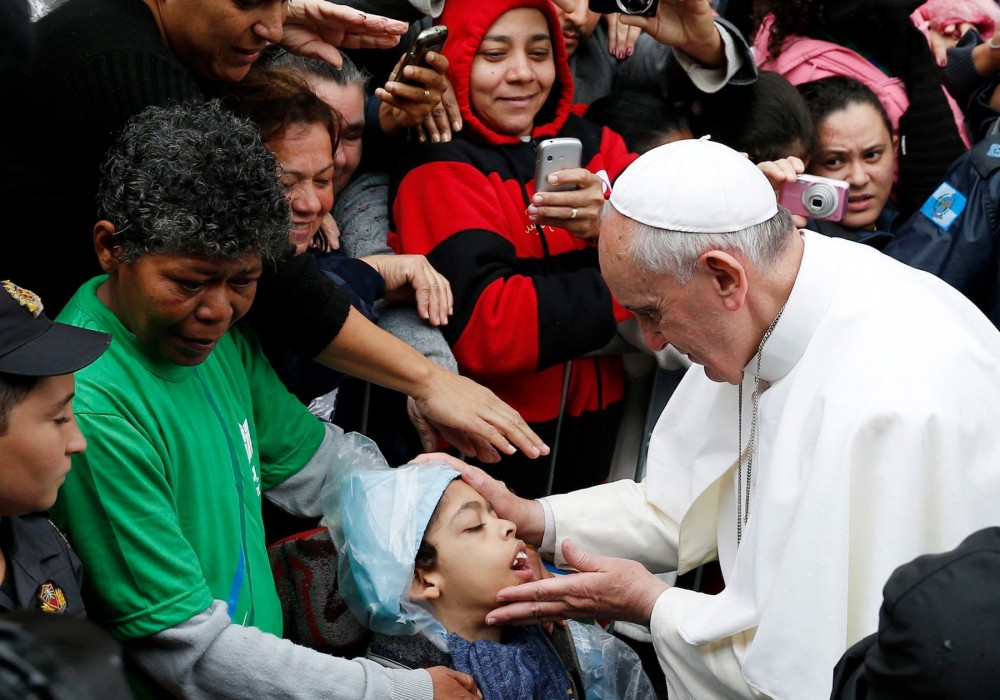
And this brings us to the culture of encounter that we so often hear about from Pope Francis. Treating the poor as a problem to be solved instrumentalizes them. We are called first to love them; second to alleviate their poverty. As Pope Francis wrote (quoting Pope Benedict XVI):
The growth of equality demands something more than economic growth, even though it presupposes it. It demands first of all “a transcendent vision of the person,” because “without the perspective of eternal life, human progress in this world is denied breathing-space.” It also calls for decisions, mechanisms and processes directed to a better distribution of wealth, the creation of sources of employment and an integral promotion of the poor which goes beyond a simple welfare mentality.
If our concern for the poor begins and ends with their material needs, then we have not understood poverty as Francis—and the Gospel—understand it. A Church that is poor and for the poor is a Church that teaches the world by example to see men and women for who they are, not simply for what they have or lack.
Editor’s note: This article is part of a series on “virtuous capitalism” designed to explore the topic in 500 words or less. The entire series may be found here.