Cardinal O’Malley and Unrecognized Christian Community

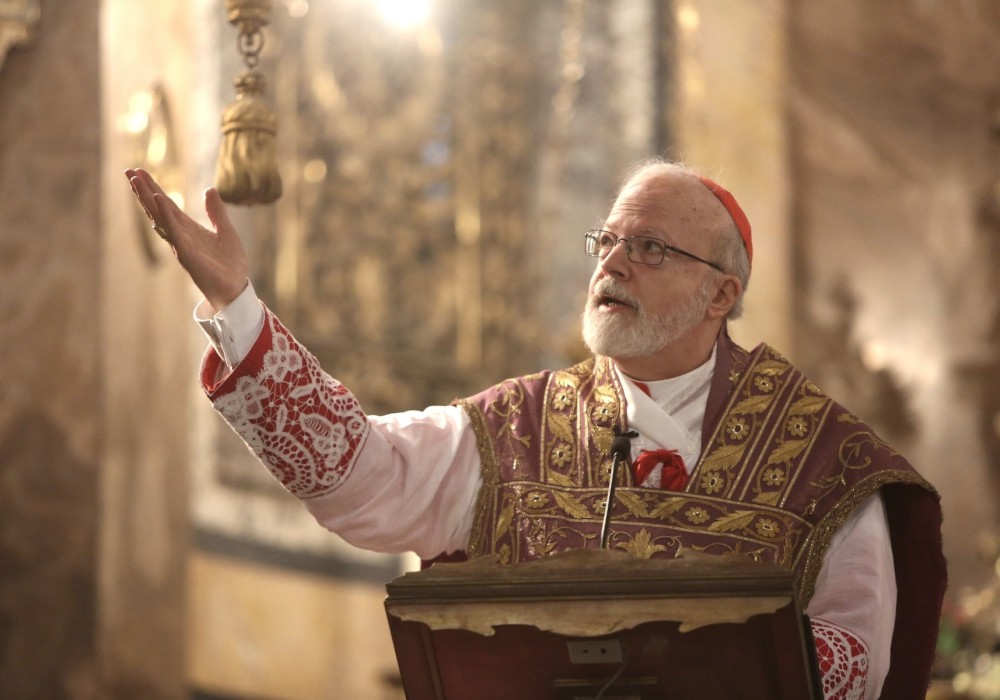
You’ve probably heard something about Robbie George’s rousing address to the 2014 National Catholic Prayer Breakfast. The speaker was, after all, Robert George—one of the more gifted and memorable orators of our day, a quality that rightly deserves some praise. What you may not have heard about, however, is the event’s keynote, to which George, billed as “guest speaker,” was really the warm-up.
Having myself attended the breakfast, I got the impression that many in the room didn’t hear about Cardinal O’Malley’s remarks either. It’s difficult not to praise Professor George for his clarity of thought and delivery; it’s unfortunate that Cardinal O’Malley’s message suffered because of it.
If George is right that “the days of acceptable Christianity are over,” it’s for all the reasons O’Malley suggests. If “comfortable Catholicism” is lost, it’s worth asking whether that’s something we should be eager to recover. And if, as George puts it, we are truly living through the Good Friday of the contemporary Church, we should also wonder what an equally desolate pre-Pentecost cenacle might look like, and whether it might in fact be a better analogy for the present age.
It’s fitting that an address to hundreds of well-connected Catholics in an underground bunker at the Washington Hilton would feature something of a call to community—even the sort of community that dabbles in provocative half-truths before finding a safe resolution in the tradition of the Church. It’s also ironic that another address would focus on the shame of abandoning Christ on the Cross, on the imperative to demonstrate and proclaim our faith in the public square, and on the implausibility of acceptance and comfort in our belief.
Professor George was speaking to the crowd gathered that morning. But I’m not convinced he was speaking at them.
O’Malley’s persistent call to community—including a trifecta of communist references—was about as jarring as one would expect. He’s made the news with his clarion call for immigration reform; but his remarks culminated with the story of the conversion of Dorothy Day. As salient as George’s “acceptable Christianity” line was this from O’Malley:
The Church’s task is to call everyone to conversion. We all have our successes and our failures. We are all struggling on the same path to holiness.
We must also break the bad habit of presenting the Church in such a way that people are deceived into thinking that they can be Christians and remain strangers. The privatization of religion in today’s climate of new age individualism is poisonous to the Gospel message of community, of connectedness in the Body of Christ.
There can be no Catholic life, no holiness, no discipleship without prayer and the sacraments. It is when the worshipping community gathers around the altar that we recognize Christ in the breaking of the bread and where, by partaking of the Eucharist, we become one with Christ and with each other.
We don’t remark on these things, I suppose, because they’re a little passé, as well as supremely unpolitical. The silence around them, however, grows deafening. I suspect we don’t speak of community beyond buzzwords not because we’re uninterested in it, but because we simply have no frame of reference for it.
Alarming enough is the prospect that our public acceptance as Christians has, indeed, come to an end. But more worrisome is the deficit we face in recognizing the reality of our current predicament. The prospects that await, I’m afraid, aren’t a quick, silent Holy Saturday with the imminent joy of Easter; rather, more likely, I think, we’ll face a surge of communitarianism—if we’re lucky—followed by another dispersion and the short, direct, and perhaps inevitable road to true apostolic witness.