Connecting the Dots on Inequality

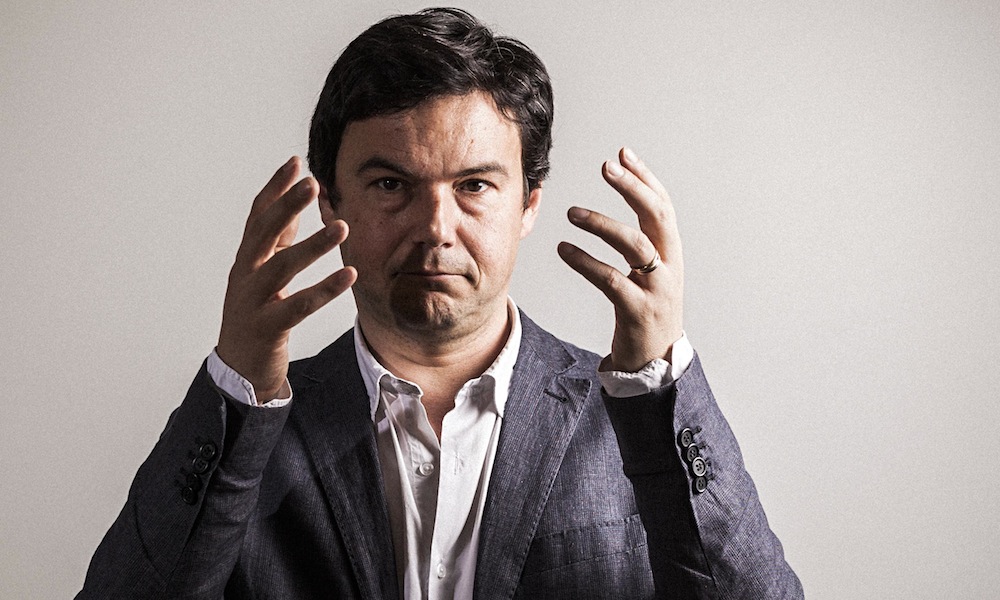
Pope Francis and Thomas Piketty have, I assume, unwittingly teamed up to incite a firestorm on the topic of inequality. The Holy Father on Monday issued this provocative tweet, while Piketty—last year—took an opposite approach by penning a 700-page book, only recently available in English. You’ve heard this all by now, so I won’t bore you.
As expected, the loudest voices contra Piketty and pontiff arise from the same quadrant, namely conservatives who see each as the representation of liberal ideologies incarnate. The tone on Piketty is manifold: either he’s portrayed as the poster boy of left-wing emotivism and rhetorical dominance, as a danger to conservatives (who without his influence could spend time focusing on bigger, better problems), or at best as a well-intentioned but short-sighted thinker whose bad arguments are important, but still unavoidably bad. I can’t really comment on any of these vis-à-vis Piketty’s actual remarks, since I haven’t yet read the book. (Neither have you, or self-admittedly certain of the above.)
On the papal front, there’s not much new to say: Francis is either a Luddite or a revolutionary, depending on which subscription you’re trying to sell. Phil Lawler gives probably the most direct interpretation of “Inequality is the root of social evil” so far: In short, it’s a (translated) play on the maxim iniquitas radix malorum. It’s a tweet that’s “making a well-known point in a different way.” Says Lawler: “That’s kinda the purpose of Twitter, isn’t it?”
Of course, the real tragedy of “inequality” has nothing to do with its role in advancing the Leftist agenda, its claim on an otherwise conveniently separated church and state—not even its logical suppositum (i.e., inequality actually present in the world). The tragedy for us all—poor and rich alike—is that the term does absolutely no service to advance a more profound, penetrating insight into how any of these actual problems can be resolved.
The Leftist agenda is a problem (so is the Left, and so is the Right). The separation of church and state—as a matter of convenience—is a problem. The real plight of those left outside the fold, whether economically, socially, or morally, is a problem. “Inequality” is not a problem; it’s a term, a proxy, for these and many other realities that we fail to speak about, and for which direct acknowledgment is the only antidote.
If there are really any dots to be connected in the Piketty-Francis firestorm, they’re not the ones you’ve been reading about. They have a lot less to do with economic models, and a lot more to do with individual people—free persons, as Peter Lawler reminds us, viewed “as much more than producers and consumers.”