


Shameless Lovers of Liberty
John Pinheiro’s new history has been published at a fortuitous moment. Billed as a religious history of the Mexican-American war, Pinheiro’s Missionaries of Republicanism (Oxford University Press) is equally a consideration of mid-19th century American attitudes towards the Catholic Church and religious liberty on the whole. And in a time when so much political attention is focused on questions of religious liberty, the brutal honesty of Missionaries is a breath of fresh air. Against the simplistic narrative of America as a unique bastion of religious freedom, Missionaries chronicles a period of ugly bigotry against Catholics in which “religious liberty” was not a shield held up in defense of the Church, but was instead the very weapon raised against it.
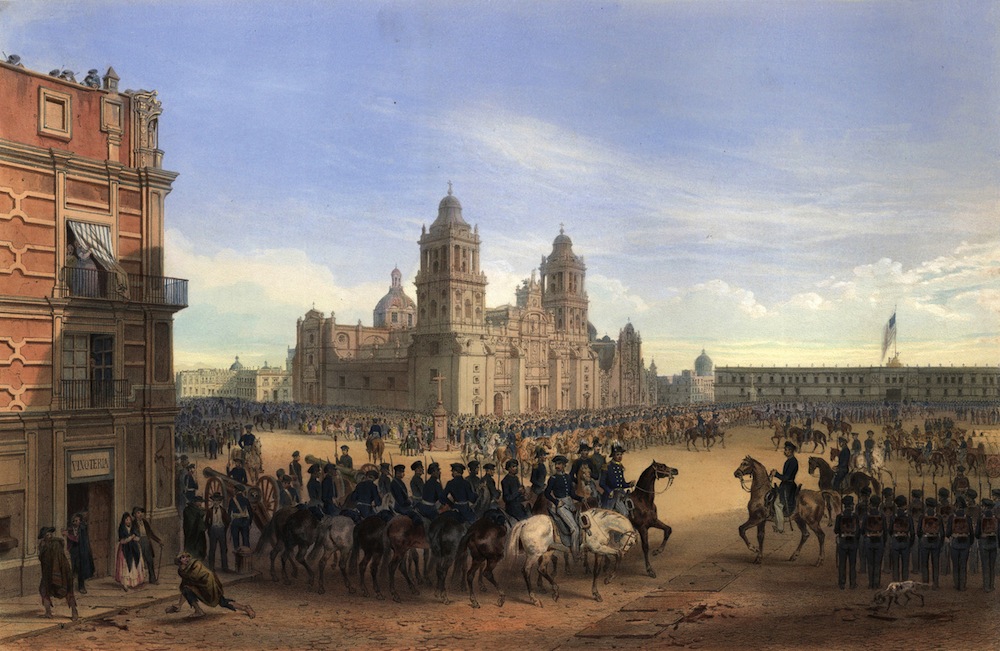
Pinheiro, a professor of history at Aquinas College in Michigan, reveals the most about the period in showing the evidence for an “almost universal discourse of anti-Catholicism” that was assumed on all sides of a cultural climate otherwise split over slavery and territorial expansion. When it came to the war with Mexico, those in favor argued that invasion provided an opportunity to remake Mexico in America’s image, spreading free institutions and Protestant religion to an otherwise backward people. Those against argued that on account of their Catholicism Mexicans were too backward to be saved, and would simply infect America with corrupt priests and idolatrous “mummery”. On the ground level, many soldiers were recruited by the promise that they could plunder Mexican churches for “golden Jesuses” hidden by conniving clerics.
In popular literature as well as political discourse in the mid-1800s, Catholics were depicted as a sinister threat to America. They were slaves to an authoritarian pope, and so threatened America’s tradition of republican self-government. Whether Irish or Mexican, they were a threat to religious and civil liberty, partisans of (in Pinheiro’s words) “mind-shackling superstition and barbarism”. Expressing a view typical of the period, the inventor Samuel F.B. Morse saw in Catholic immigrants a Papist conspiracy to send “priest-ridden troops of the Holy Alliance, with their Jesuit officers well skilled in all the arts of darkness” to take over America.
One of the strengths of Missionaries of Republicanism is that it refrains from oversimplifications about the interplay between this overwhelming religious prejudice and the racial and class conflicts that are also hallmarks of the antebellum period. In the 1834 burning of an Ursuline convent in Boston, for example, Pinheiro is careful to note that class interests worked alongside virulent anti-Catholicism, as the working class rioters were upset at wealthier Bostonians who had sent their children to the nuns to be educated. Even more fascinating is the way in which “Anglo-Saxon” replaced “white” in the terminology of race, as the former term made it more apparent that Irish Catholics immigrants ought to be excluded.
Because of this melting pot of prejudices against non-Protestants and non-whites, one could read this history as but one story of prejudice amongst many in our past. But Pinheiro gives us an important theological insight: there was at least some truth to the charge that Catholicism was inimical to religious liberty and republican forms of government. He points to Pope Gregory XVI’s 1832 encyclical Mirari Vos, which chastised the revolutionary Enlightenment “shameless lovers of liberty” who thought that civil freedoms were more important than religious truth. Freedom of religion and conscience were no good, the Pope argued, if they insisted on ignoring the higher purpose God had given to man. On the whole, the theory of freedom advocated by liberals would lead to error and discord.
Thus the American conviction that Catholicism threatened their liberties was not entirely unfounded. The perceived conflict between Catholicism and religious freedom was not an unrelated prejudice grafted awkwardly onto liberal political theory and doomed to eventual defeat, as might have been the case with southern defenses of slavery. Rather, it followed a perfectly valid conceptual logic:
To oppose the one particular religion that promised to squelch all others and weaken Americans’ hard-won civil liberties seemed perfectly consistent with the principle of religious freedom and not at all hypocritical to a growing number of Americans by the mid-1830s. That is, limiting the freedom of Catholics, especially those recently arrived from a European monarchy with no experience of self-government, actually ensured religious freedom…The truth of this paradox seemed as sensible and as uncontroversial as confining criminals to jail in order to protect the community from further crime, as opposed to letting them run free in the name of liberty, hoping all the while that they might morally regenerate on their own.
Ross Douthat thinks that today’s shameless lovers of liberty are hypocrites- they advocate tolerance but practice intolerance. But Pinheiro’s history shows us that it is certainly possible, and perhaps even the historical norm, to be a missionary for the liberal cause of republicanism, and a forceful advocate for freedom. Why should we expect today’s liberals to be any different? Liberal societies have always drawn boundaries around freedom in order to preserve it, and it is becoming clear that today as in the 19th century these boundaries exclude the teachings of the Church. Progressives are not sheepishly and hypocritically hiding behind rhetoric about freedom to mask ideological pressure, as Douthat claims, they are openly using ideological pressure to preserve and expand freedom as they understand it.
We ought not to be so shocked by these developments, and we ought not to delude ourselves into believing our adversaries can be talked down by repeated invocations of religious freedom, tolerance, or liberty. Our shameless lovers of liberty will not bat an eye when they are accused of hypocrisy, for like the anti-Catholics of the 19th century, their theory at least is consistent: in order to be free, the impediments of the past and the vestiges of prejudice and superstition must be eliminated.
In practice, American Catholics gained status after the 19th century in part by assenting to our liberal regime. Irish immigrants in the Mexican-American War signed up to fight their coreligionists, a decision ironically made easier because anti-Catholic prejudice made it hard for them to find work elsewhere. On the theoretical level, American Catholics ignored Mirari Vos and began to accept in theory the absolute moral priority of free choice. In practice they began to deny their own right to bring their religion into the public square by choosing to argue on secular grounds. One may argue that the effects of such a compromise were salutary through the 20th century, but each week brings more news that the jig is up. The bigots are back, and American Catholics will need a new way forward.