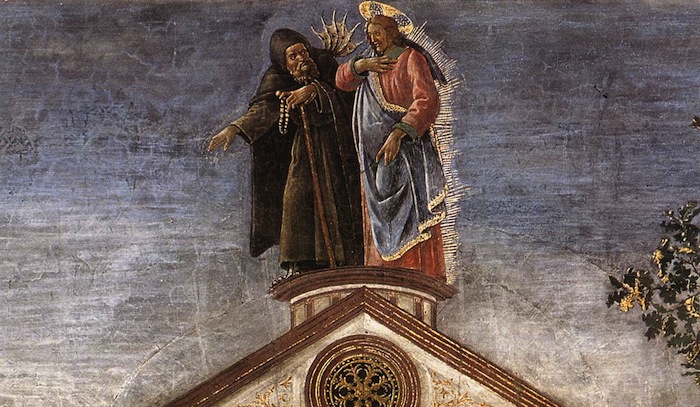
temptation-botticelli

Don’t Say Gay: Against an Unnatural & Unhelpful Categorization

By | June 27, 2012

Over at First Things, Joshua Gonnerman recently argued that Dan Savage was right in his admonition of Christians today for not being sufficiently loving towards “gay people.” And in a follow-up essay, Gonnerman went on to advocate for the cultivation of a “gay Christian” identity as one important avenue for overcoming this failure to love.

While I appreciate Gonnerman’s concern for correcting this very real immorality within our Christian flock, and while I am sympathetic to his desire to strengthen the bonds of community amongst those who struggle here, I believe his proposed solution is both deeply metaphysically flawed, and ultimately counterproductive to our Christian cause. Rather than acknowledging and baptizing this “gay identity,” we ought instead to discard it completely, for it has no natural basis in reality, and in the end it only hinders the solidarity we ought to be cultivating with these and all our Christian brethren.

The theoretical problem with the “gay identity” language our culture is so bent on selling us, is that such diction treats a random, non-natural property as natural, as essential, and as central to man’s very self. Gonnerman explicates the present objection as a complaint against the scope of the identity label: “’You can’t identify as gay,’ many said, ‘because to do so is to say that the label ‘gay’ encompasses you in your totality.’” But the real problem with this identity language is not that it implies comprehensiveness, but rather that it implies naturalness. The point is not that “gayness” isn’t all-encompassing; no party to the debate thinks that it is. The point is that “gayness” is not in any way natural, i.e., that a sexual orientation is not an essential property of man in virtue of his humanity. It is merely a reductionistic cultural construct that mistakenly treats a complicated, dynamic, and chance set of tendencies, attractions, and temptations as a simple, static, and basic fact about man’s nature.
Gonnerman rightly notes that a certain linguistic debate has taken center stage in Christian conversations about how to correctly respond to the culture’s “gay identity” line. Our thinkers now argue heatedly and frequently about what term we ought to employ to categorize this particular group of people: whether “gay” is acceptable or perhaps takes it all a bit too lightly, whether “homosexual” is preferable because of its impartial clinical connotation and more traditional roots, or whether “same-sex attracted” is best since it clearly distinguishes between a basic human identity and merely a sinful human tendency. But while those who debate this terminological question no doubt have the best of intentions, their conversation is inherently erroneous from the get-go. For any discussion about how to categorize this group necessarily presumes that we indeed ought to categorize this group. This, I believe, is a crucially mistaken premise.

In truth, the collection of people who struggle here are no more a natural kind than those who experience temptations to theft, or gambling, or dishonesty, or anything else. We don’t have a nice, neat, concise way of referring to any of those categories of people, mostly because we rarely do refer to that random collection of people as a group. None of them, of course, are natural kinds. And it should be the same here. In adopting a term for this set of people, any term, we make the group out to be something more than a chance collection of folks who happen to struggle with, amongst many other things, temptations against chastity with members of the same sex. We perpetuate the central misunderstanding of the culture here by willingly grouping them as one, as though they together formed a natural kind in virtue of this random property.

At times when, as in the case of the present discussion, it becomes necessary to speak specifically of this set of people, I recommend exceedingly messy and cumbersome turns of phrase. The clumsiness of the diction hammers home the point that this is not a natural group in any sense. Perhaps we could try something along the lines of “all those men or women who have, either at one time in their life or on a more consistent basis, been tempted to some sort of sexual immorality with another person of the same sex,” or some such thing. And the messiness of the phrasing should also deter us from referring to this chance collection of people more frequently than we ought to, which, I suspect, would be not very frequently at all. Blanket statements about this random group do little to advance our cause, and much to cement the flawed ways of thinking that benefit the opposing cause of our culture.

In addition to the metaphysical errors of Gonnerman’s position and their unfortunate linguistic offspring, there is also a practical, pastoral reason to discard all notions of “gay identity.” Our ultimate goal here, according to Gonnerman, should be to welcome into our Christian family all those who struggle with this temptation and thereby feel alienated as a result. I quite agree with Gonnerman on this point; that is how Christ would treat them, and so that is precisely how we should too. But notice, there is no essential difference there in how we ought to treat those who are burdened with this particular temptation as opposed to any other. After all, we should welcome all people, all struggling sinners, into our familial Christian community. And by separating this particular set of postlapsarian men off from the rest, we hinder the family ties we were meant to cultivate with them. Grouping them off in our mentality, we also set them apart in reality, creating a division that is antithetical to the solidarity and friendship they need.

Having myself had many friends who struggled violently against this temptation, I can say from experience that a central facet of the struggle involves battling feelings of extreme isolation. They, like all the rest of us, intensely desire to love and be loved. They long for intimacy, but find a wall separating them from those who cannot empathize with their burden. My suggestion here is simply that we should tear down this wall, for it has no natural basis and serves only to intensify their sense of alienation. Perhaps I do not struggle with this particular temptation on any kind of regular basis, but so what? I struggle with all sorts of things my friends may not; that doesn’t require me to construct mental barricades between us.

We are all Fallen. It is in that common human condition, and in our common Christian answer to it, that we ought to build up our familial community. There is, no doubt, plenty of diversity and otherness we will have to confront along the way, but let’s not multiply our differences needlessly, or intensify their seriousness just because the culture commands us to.

Gonnerman writes that, “while there are interesting questions about whether it is good that sexual identity exists in our culture, the simple fact is that it does exist.” But whether such cultural imports are good is precisely the question we ought to be asking. If such notions of identity reflected reality and furthered our Christian goal, then perhaps we would be right to adopt them ourselves. But, as I have argued, they ultimately do neither of these things. Such identity confusion is both metaphysically untenable and pastorally counterproductive.

So I come at last to a simple challenge to my Christian brethren: Please, don’t say “gay.” Really, don’t say anything to reinforce the mistaken idea that there is some essential difference between “us” and “them.” Instead, go out and love and befriend these individuals as you would any other. For they are no different than any other. They are your brothers and sisters in Christ, and however much of a struggle this is for them, it is no different in kind from any of the rest of our struggles. Be Christ to them, and let them be Christ to you. Because guess what: You’re broken too.


Print Friendly
  • http://jlleblanc.com Joe LeBlanc

    “They, like all the rest of us, intensely desire to love and be loved. They long for intimacy, but find a wall separating them from those who cannot empathize with their burden.”

    Does this wall exist because they’ve been categorized? Or because they don’t feel they can share their burden with others without having a debate over labels?

    I think that asking “all those men or women who have, either at one time in their life or on a more consistent basis, been tempted to some sort of sexual immorality with another person of the same sex,” what they actually prefer to be called would do far more to tear down walls than asking everyone to stop saying “gay.”

  • RevJames

    Jesus looks totally GAY in that pic you have of him in this article.

  • Andrew Haines

    I’d normally have deleted your comment, since it’s clearly irrelevant. But hopefully leaving it up will be a lesson that 1) most proponents of the “gay” identifier have a pretty shallow sense for what constitutes it, and 2) Michael’s challenge might in fact be worth pursuing.

  • http://dubitodeus.wordpress.com/ Robert

    (1) doesn’t follow. Your sample size is one. You also can’t say that he’s even a ‘proponent of the “gay” identifier’ in the first place, because he’s clearly a troll. Trolls don’t say things because they believe them, but because they’ll incite a response. The best way to deal with trolls is to simply ignore them.

  • Andrew Haines

    Robert, you’re probably right on the last point, at least. If being “a lesson” demands that (1) follow directly, then you’re right about that, too. But I think that’s being sort of stringent!

    I would (as always) be curious to hear your input on Michael’s piece, more generally.

  • Sam Preston

    Very interesting piece, Michael. As you likely realized from our time together in philosophy classes at Columbia, you and I begin our philosophical investigations from extraordinarily different starting points and intuitions, but I’ve yet to see you make a point that does not follow impeccably from your basic assumptions.

    Two questions arose for me as I read the piece:

    First, have you read the first volume of Foucault’s History of Sexuality? I ask because you and Foucault are (perhaps surprisingly) not so dissimilar in your thoughts regarding the role of categorization in identity construction, particularly as applied to homosexuality. I wonder how you would compare his thoughts to your own; in particular, I wonder about your thoughts on what brought about the categorization of sexualities, as your thoughts on that topic might be directly relevant to the practical possibility of discarding all notions of gay identity.

    Second, and related, I wonder about how exactly you differentiate natural-type identities from categorization-constructed identities. I myself am inclined to reject the reality of the former and accept the latter exclusively, in large part because I see no reason not to take the personal acceptance and affirmation of a given conception of one’s identity to constitute that identity’s metaphysical and normative “realness.” But explicating my own views isn’t important here. I simply wonder what you take to ground natural types in general (getting around such problems as “grue,” etc.), how you apply that account to the domain of identities, why natural-type identities are metaphysically “real” in a way that categorization-constructed identities are not, and why that metaphysical “realness” has particular normative importance. I’m sure you’ve written about these matters elsewhere; I imagine that your answers largely invoke Thomistic metaphysics? Either way, I’m confident that a longer piece addressing some of those issues in conjunction with your thoughts on sexuality would be of great interest even to non-religious persons like myself who are interested in the intersections of metaphysics and sexuality theory.

  • Joshua Gonnerman

    A few notes on points of apparent misunderstanding.

    First, you seem to be under the impression that I hold to an essentialist view of sexuality. I do not. I regard it as historically naive to regard the concept known as “gay” to be an inherent part of human experience, simply because the experiences of same-sex sexuality across cultures and history have been too widely variant to be realistically equated with modern homosexuality. Gay identity is most certainly a social construct. But I acknowledge the powerful subjective reality of social constructs, and our deep embeddedness in those constructs. My point about the existence of sexual identity was precisely that it is too deeply embedded in the society all of us have grown up in for us to truly abandon it; we can not say straight, or we can not say gay, but the thought patterns remain in our minds. Sexual identity will, likely, disappear one day. Until then, it is more fruitful to engage it than to bury one’s head in the sand.

    Second, many people do, in fact, seem to regard gay identity as necessarily a totalizing identity. This is the official line of Courage: “There is more to a person than one’s sexual attractions. Even if one experienced same-sex attractions for most of one’s life, he or she is first and foremost a child of God created in His image. To refer to that person as “gay” or “lesbian” is a reductionist way of speaking about someone.” The line of argument, “there is more to a person than sexual attractions, thus to refer to a person as gay is reductionist” only makes sense if it is assumed that “gay” is meant to express the totality of a person’s being. I think I am reasonably familiar with the world of Christian response to homosexuality, and this line of reasoning is very common.

    Third, I know many such people as you refer to at the end, who themselves feel alienated by the term “gay.” I attempted (unsuccessfully, apparently) to delineate between those who feel that gay describes them, and those who do not. I recognize the validity of their experience, and I go to great lengths not to describe them as gay; they have rejected that identifier, and I strive to be sensitive to that fact. I was, in fact, precisely trying to distance myself from the argument made by many that “gay” and “same-sex attracted” mean the same thing, in order to recognize the validity of the experience of those who don’t identify as gay.

    I know many, many people who, like myself, identify as gay and are committed to chastity; with a few exceptions, all my nearest and dearest friends fall in that category. I spent this past weekend in a cabin with fourteen of them. And I can say from deep-rooted experience that insisting on the universal rejection of the term “gay” is, for them, the exact same experience of alienation and isolation you describe for your struggling friends.

    I am not trying to insist that strugglers use my words or drink of my cup. I regard a basic part of Christian kindness is allowing them to tell their own stories. All I ask is that I, and those like me, be allowed to tell ours, as well.

  • Jessica

    I don’t necessarily agree that the category is not a natural one. Twin studies have shown that while not entirely genetic, there is a genetic component to the same sex–attracted identity. As much as I’d like to simplify the issue and say God doesn’t make mistakes, so this trait must not be of God, i.e. unnatural, I don’t think it’s that easy.

    I’d liken a same-sex attraction to many other traits and propensities which, while not yet proven to be physiological, do tend to run in families regardless of environment. My own family has a history of alcoholism. Others carry lines of depression, suicidal tendencies, kleptomaniac tendencies, eating disorders, schizophrenia, hoarding, or ADHD. These propensities, like same-sex attraction, are disordered and yet to some extent heritable.

    In my view, these tendencies are real and capable of being categorized. None of them compel one to sin, but they all cause increased temptation in some area.

    In the vernacular of the alcoholic, one is always a “recovering” alcoholic and never “recovered,” because it must be remembered that, even after decades sober, the risk of relapse always lurks until we receive our heavenly bodies. (In that vein, one family member who has never touched a drop of alcohol in her life identifies as a would-be recovering alcoholic due to family history and her own addictive personality.) I think that identifier is apt for “recovering homosexual” Christians, too. Perhaps, due to genetics, hormonal imbalance, past abuse, or a lifetime of this identity, they’ll never be able to identify otherwise. In that Although temptation will atrophy with disuse, it may never be fully removed, but the Christian will always have the ability to reject sin and find comfort in Christ no matter what their propensity.

  • http://www.facebook.com/profile.php?id=7611494 Mark David Guillaudeu

    I think this conversation would be very much helped by an explication on Mr. Hannon’s part of what constitutes “natural” or “naturalness” in traits; it seems to me that homosexuality’s/gayness’/same-sex attractedness’ “unnaturalness” is crucial to his argument. However, nowhere in the article is the root or cause of this unnaturalness laid bare to the light of day and argument. I wonder further by what instrument, granting the reality of such natures, Fallen man might detect such natures? Thank you!

  • Andrew Haines

    I assume—from context, and the character of his conclusions—that Hannon means nature in the Aristotelian “principle of motion or stability . . . in a thing to which it belongs primarily and per se” sense. Or, maybe simpler, a quality of things that obtains “always or for the most part.” (If I’m right about this, I think the author would have been hard pressed to offer even a moderately defensible account of nature, given the length and direction of the article.)

    As for detecting them… well… read Aquinas, Scotus, Ockham, and Burley and get back to me :) I’m eager to know, as well!

  • Michael W. Hannon

    Thank you all for your comments, and my sincere apologies for the long delay in responding. A special thanks to Mr. Gonnerman for his contribution here, and to my old philosophical sparring partner Sam. I’ll do what I can to engage with the concerns raised here.

    First off, I think Andrew has done as well as I could’ve in explicating what exactly makes something a natural property as opposed to a non-natural one in the relevant sense. Nature is, according to Aristotle, a “principle of motion or stability… in a thing to which it belongs primarily and per se [through itself]”. It is simply the what-it-is of a thing, its form, its identity qua species. Recognizing what is properly said to belong to that and what is not is far from simple, but we get a clue when we look across times and places and note what all (or at least by far most) cultures agree is a central fact about man’s being.

    My argument here is that sexual orientation (or even sexual identity more generally) is not in any way rooted in the nature of man. There is no accident inhering in him of “sexual orientation”. This is a classification our age has created to divide men into that class most often attracted to persons of the same sex, and that class most often attracted to persons of the opposite sex. (And it seems Mr. Gonnerman and I agree up to here that sexual orientation is, at any rate, not a natural property. We simply differ in our assessments of the relative merits of employing it as a non-natural classification scheme. Is that fair, Josh?)

    Now, on the one hand, there is nothing wrong with such a classification in itself, anymore than there is of classifying according to the “grue” schema that Sam mentions, or of classifying those genetically predisposed to Alzheimer’s and those who aren’t. And if this categorization of sexual orientation was used infrequently and with awareness of its non-natural status, I wouldn’t be all too concerned about it. But we take this classification very seriously indeed (in large part probably because we take sexuality far too seriously), and we seem to think it refers to a brute and basic fact about man.

    I’d be very curious to know, Mr. Gonnerman, what you believe most people mean (and what you yourself mean) when they claim to be gay. My concern is that it is not understood or treated as non-natural or socially constructed at all, but as something of a sacrosanct property that gets at the very core of human essence.

    To Jessica, hopefully it’s clear-or at least clearer-now that our meanings of ‘natural’ differ here. It well may be the case-and as you say, studies have strongly suggested it is indeed the case-that there is a genetic component to homosexual attraction. There is also a genetic component to alcoholism, and there could well be to gambling addiction and to kleptomania and to pedophilia. And in none of those cases is it right to say that “God made a mistake”. Our nature, recall, is broken. The Fall wounded us, and there is no reason to think those wounds couldn’t be reflected in our DNA. But the question is whether we are right to jump from the statement “I experience homosexual attractions far more often than heterosexual attractions” to the statement “I am a homosexual”. These adjectives-‘heterosexual’ and ‘homosexual’-until quite recently referred only to actions and to attractions (really, temptations) to those actions. To use them to classify people is very historically novel, and I’m arguing, not terribly helpful.

    To Sam, briefly, I don’t presume the naturalness of this property has anything at all to do with the relevant ethical questions here. I hope I didn’t seem to. I simply didn’t address those here because of the intended audience of this piece. I don’t pretend to have proved sodomitical acts immoral in the above. That task simply fell outside the purview of the present project. I’m happy to discuss that elsewhere though, if you’d like.

    Mr. Gonnerman, you’re also perfectly right to point out that many people and groups, Courage included, think the gay identity is totalizing and comprehensive. I didn’t mean you were wrong to respond to those groups-quite the contrary. But my perception is that it is almost exclusively those kinds of groups who claim that it is totalizing. No one identifying as homosexual thinks that that exhausts their humanity, and neither do you, and neither do I. That’s all I meant when I said no party to this debate thinks disagrees there. What we do disagree about (you and I vs. the culture at large, I mean) is whether this property is essential or constructed.

    I’ll finish this post (though I’m happy to continue the conversation past this point) with one final observation. It seems to me that one of the worst consequences of embracing the sexual orientation scheme is that it leads us to conclude that all “homosexuals” (really, just that chance collection of folks who happen to struggle frequently with attractions to members of their own sex) have only one live moral choice in response: lifelong celibacy. But why should that be the case? If I’m right, and this distinction is a pretty pointless one, then why shouldn’t we think that these folks can get married too? I think we make this set of temptations out to be far more disastrous for the individual suffering with them when we enshrine them in the language of identity / orientation. So when Stephanie walks down the street she has to guard her eyes and mind more in response to the women than the men. Who cares? It’s a far leap from there to the conclusion that Stephanie can never enter marriage. *Unless* we set her off as some kind of essentially different *kind* of person, one who only could pair with another woman rather than a man. But this, I have argued, is silly.

    Consider these two authors (both of whom, I concede, do identify as gay, though I would counsel them to rethink that of course), who have recently come out with their stories of fruitful marriage despite struggling with attractions to members of their own sex:

    http://www.catholicsistas.com/2012/01/19/confessions-of-a-recovering-lesbian/
    http://www.catholicsistas.com/2012/04/12/life-after-lesbianism/
    http://www.joshweed.com/2012/06/club-unicorn-in-which-i-come-out-of.html

    This seems to me perfectly legitimate, and perfectly advisable. But I doubt we can make much sense of it for as long as we’re employing these distinctions seriously.

    Feel free to hit me back with more comments. I’ll try to respond more promptly in the future. Thanks again for y’all’s patience, and God bless.

  • Michael W. Hannon

    The following is a longer comment I left elsewhere to others who raised questions about this piece. It’s taken out of its context, but may perhaps be enlightening here anyway:

    Thank you all for the comments, and apologies for the delay in replying. And Brafford, for the record, you are welcome to show up at my house unannounced anytime you like. :-)

    I wish I had the time and the intellectual resources to respond to all of this comprehensively, but I must admit that I have neither. So rather than trying to argue all of this point-by-point, let me paint in broad strokes what I intended this piece to be.

    The common complaint of the “Gay Rights Movement” seems to me to be that there is an unjust discrimination currently enshrined in our laws that privileges “heterosexuals” over “homosexuals”. Such a claim presupposes a real difference between these two groups of people (or for the more PC, as Kevin has pointed out, between “heterosexuals” and a large number of other groups). And as Peter has said, the creation and popularization of this belief has been the most significant victory of the “Gay Rights Movement” to date. For once we concede that these two (plus) classes of persons exist, that the division of these classes according to sexual desire has a significant basis in reality, our egalitarian culture will inevitably make this into just another civil rights issue.

    Yes yes, we can (and should) challenge said egalitarianism in general, and argue along with Aristotle that justice demands not only the treating of same cases the same, but also the treating of (relevantly) different cases differently. But I think we’ve already conceded too much if that’s where we start this particular debate.

    Let’s back up. What does someone mean today when they say that they are gay? Not, I think, that they have chosen to identify with a certain group for the sake of making sense of reality, even if we can diagnose that as the ultimate cause of said identification. (If that’s what they meant, then all of this talk of being gay not being a choice would be obviously nonsensical.) I think what the vast majority of people mean when they claim to be gay is that they believe people by nature fall into one of two camps: those who are primarily attracted to persons of the opposite sex, and those who are primarily attracted to persons of the same sex–and that they happen to fall into the latter camp. My claim here is that this conception of camps is really worthless and not at all grounded in reality. It’s not that we should ditch the homosexual label so that everyone may understand themselves as heterosexual. It’s that both labels are mistaken–sexual orientation is simply a social construct (and historically a very recent one), not a fact about man grounded in his being. We may argue about the relative importance about things like sex, height, skin color, country of origin, etc., but those are all properties that are natural in the sense I mean here–they are all objective properties inhering in this person’s being. There is no accidental form of sexual orientation.

    Peter claimed above that, until very recently, it was understood that “everyone was by nature heterosexual, but subject to sexual temptations of wide and varied kinds”. That, I think, is only half-true. I’d say instead that no one was conceived of either as heterosexual or homosexual, but that all were subject to sexual temptations of wide and various kinds. Now if by ‘heterosexual’ is meant simply fulfilled in virtue of their human nature by a sexual relationship with someone of the opposite sex, then sure, everyone was understood to be heterosexual. But that’s not what people mean by heterosexual today. It has nothing to do with what is good or fulfilling of man in virtue of the end for which he was made. It’s just a brute fact about which direction his attractions primarily go in. Pre- sexual orientation, it’s not that everyone was understood to be most often attracted to the opposite sex. It’s just that which sex people were most often attracted to wasn’t treated as a terribly important piece of information. And, I’m arguing, we shouldn’t give it too much weight either.

    Re: Brafford’s closing remarks, I’m not claiming the wall between this “us” and “them” has already been torn down, but I’m claiming that we’re the ones who built it (we meaning men in general, not “heterosexuals”–I just mean to say it’s not grounded in human nature somehow), and that we built it foolishly, and that perpetual employment of this system of categorization guarantees it will never be dismantled.

    Perhaps I’m just more optimistic than some that we can indeed turn back the clock on this whole business of sexuality. To borrow from Chesterton, the clock is a human invention, and insofar as it’s keeping bad time, we can and in fact ought to turn it back. I’m not naive about how difficult and seemingly impossible a process that will be, but it strikes me as no more difficult (and a good deal more effective and prudent, insofar as we can actually do it) than accepting and baptizing this notion of sexual identity.

    Further comments welcome. God bless, all.

  • http://youth-masculinity.blogspot.com Suresh

    The strongest objection to the homo-hetero categorization is — and its one that westerners can’t seem to ever understand, least of all analyze — is that, the concept of ‘homosexual’ actually refers to ‘third genders’ — i.e. non-males ‘men’ or males without manhood, which is orignally the category of all those people who were both males and females at the sametime, in one way or the other (e.g. having male body and female spirit, or being effeminate).

    the third genders created the concept of ‘homosexuality’, they are the ones that mostly relate with it and perpetuate it. It is not the appropriate identity for males with manhood.

    For more on this, please go to this site:

    http://men-masculinity.newsvine.com/

  • Ellen K

    I think I agree mostly with what you are saying here but let me offer a few thoughts.

    “In truth, the collection of people who struggle here are no more a natural kind than those who experience temptations to theft, or gambling, or dishonesty, or anything else. We don’t have a nice, neat, concise way of referring to any of those categories of people, mostly because we rarely do refer to that random collection of people as a group.”
    Thieves, gamblers, and liars? I imagine there are times we refer to liars as a group. Maybe teachers at a conference discussing how to best communicate with students who lie. Having made the point that we do refer to these groups, I’ll add that I prefer “those who lie” to “liars.” I tell my own students that calling someone a name isn’t fair; we should address the behavior- your friend isn’t mean (or other negative words) but perhaps is acting mean, or did something that felt mean. After all, I struggled with lying as a kid but I hope people don’t think of me now as a liar. I believe I was a liar because I lied often. The danger is that from the label comes assumptions, assumptions that the “liar” is always lying or always will lie not to mention the distinction between having a propensity for lying and actually lying.

    I think someone else made the good point that these labels are only reductionist if they are meant to describe the entirety of a person’s identity. I am a woman, but I am not only a woman. I am not married, and even though this does not paint a complete picture of my identity, it is a true descriptor.

    The general sentiment of breaking down the barriers that exist between all people and embracing our common human weakness should be present in the Christian community (and everywhere). My mother, whom I regard as a very wise woman, used to correct her children if we said, “I did xyz; I was so stupid!” telling us to instead say “I was so human.” It sounds silly, but is so much closer to the truth than its normal sounding counterpart. If not saying “gay” were the right path, I’d be up for sounding silly. I think the best point made in this article was that we should question how often we need to use such a label and why.

  • Dan H.

    “But the real problem with this identity language is not that it implies comprehensiveness, but rather that it implies naturalness. The point is not that “gayness” isn’t all-encompassing; no party to the debate thinks that it is. The point is that “gayness” is not in any way natural, i.e., that a sexual orientation is not an essential property of man in virtue of his humanity. It is merely a reductionistic cultural construct that mistakenly treats a complicated, dynamic, and chance set of tendencies, attractions, and temptations as a simple, static, and basic fact about man’s nature.” Would this critique of “identity language” also apply to to cultural (Hispanic), racial (White), ethnic (Japanese), economic (Middle Class), Linguistic (English speaking), religious (Hindu), and gender (female) identities? If not why not?

  • Ryan Dowell Baum

    “In truth, the collection of people who struggle here are no more a natural kind than those who experience temptations to theft, or gambling, or dishonesty, or anything else. We don’t have a nice, neat, concise way of referring to any of those categories of people, mostly because we rarely do refer to that random collection of people as a group.”

    Of course we do: thieves, gamblers, and liars. Just as we talk about these categories of people, we can talk about people who desire (and have) sex with people of the same gender. The question upon which Christians disagree is not ultimately about whether or not “sexual identity” exists, but about whether same-gender sexual intercourse is inherently sinful, and about whether people who desire and have sex with people of the same gender (i.e. gay people) should be classed along with thieves, gamblers, and liars.

  • Mr Fapdeaux de la Papillon

    So then implicitly youd argue that there is less than a gay identity as there is gay behavior?

  • Antiochus

    There is incontinent giving-in to disordered desire, which is no fundamentally different from any other. Saying that there is a “gay” behavior is already to classify that behavior as “the sort of thing” that that “sort of person” does, and so to see the identity as either the substrate, or the hypostasis, of the behavior.

  • Matt

    Such a large part of your premise is that same sex attractions are a “temptation” in every case. Someone with same sex attractions is capable of experiencing an attraction without being tempted to physically engage with the person they find attractive. Often these go hand in hand, and often they are consecutive experiences, but they are two different things. Just like a heterosexual experiencing attraction to someone who is not their spouse is not the same as a temptation to adultery. It would be sinful for that person to have sex with someone beside their spouse, yet that experience of finding people of the opposite sex attractive cannot be seen as a “temptation” in every case, but it will still shape them profoundly. So I think that it is not the “temptation” to sin that people use to categorize, but the experience of attraction which is separate from this. I think this distinction makes your comparisons that you provide less apt.

  • HomophobiaIsTheAnticchrist

    “Gay indetity”? Kind kind of thing is that? If you are heterosexual does that mean there is a “straight identity” thus all heterosexual people should behave the same way? In other words, no one is unique but just a bunch of creatures with no individuality. What a reductionist and discriminatory statement.

    Homosexuality is not a temptation but a sexual orientation. A homosexual person is no more sexual than the average “christian” is, although the fixation with sexuality suggests to me that “christians” are very sexual people.

    Also, homosexuality unnatural?
    Homosexuality in the animal kingdom https://www.youtube.com/watch?v=LFeXwKnCUNI

    By the way, ironically, the bible contains a homosexuallove story: David and Jonathan.